
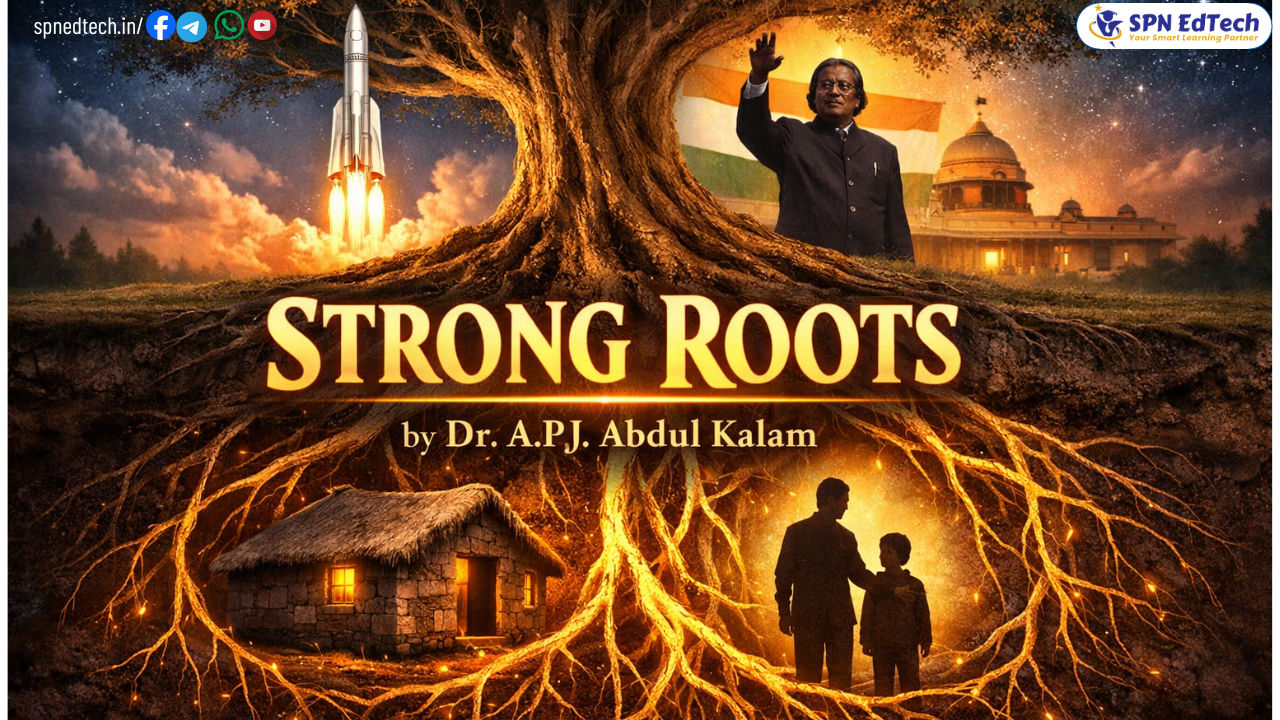
📖 Chapter Name: Strong Roots (An extract from 'Wings of Fire')
✍️ Author: Dr. A.P.J. Abdul Kalam
🏫 Class: Class XII (Semester - 3)
📌 Genre: Autobiography / Prose
🌍 Context: This piece provides a glimpse into the early life and spiritual upbringing of India's 11th President.
Dr. A.P.J. Abdul Kalam (1931–2015) was one of India's most distinguished scientists and served as the 11th President of India from 2002 to 2007. Known as the "Missile Man of India," he played a crucial role in India's civilian space program and military missile development. His writing style is simple, evocative, and deeply spiritual. In "Strong Roots," he recounts his childhood in Rameswaram, emphasizing how his father’s wisdom and his mother’s kindness shaped his worldview. His famous works include Wings of Fire, Ignited Minds, and Indomitable Spirit.
"Strong Roots" is an evocative narrative where Kalam describes his middle-class Tamil family in the island town of Rameswaram. He was born into a family where his father, Jainulabdeen, possessed great innate wisdom despite having little formal education or wealth. His mother, Ashiamma, was an ideal helpmate who fed numerous outsiders every day.
Kalam grew up in a secure childhood, both materially and emotionally. He lived in their ancestral house built in the mid-19th century. A significant part of the story revolves around the communal harmony of Rameswaram, where the high priest of the Shiva Temple, Pakshi Lakshmana Sastry, was a close friend of Kalam’s father.
The narrative highlights Kalam’s father's spiritual teachings. Jainulabdeen believed that prayer allowed a "communion of the spirit" between people. He taught Kalam that every human being is a specific element within the whole of the manifest divine Being. Therefore, one should not be afraid of difficulties or suffering because adversity always presents opportunities for introspection.
The Power of Faith: The central theme is how spiritual strength can overcome physical limitations. Kalam’s father used to explain complex spiritual concepts in very simple Tamil.
Communal Harmony: The text portrays a world where people of different religions lived together in peace, discussing spiritual matters.
Parental Influence: It emphasizes that the 'roots' of a person’s character are formed by the values inherited from parents. Kalam's scientific career was deeply rooted in the spiritual foundation laid by his father.
"Adversity always presents opportunities for introspection": This is a crucial line. It means that when we face hard times, we should look within ourselves to understand why we are suffering and what we can learn from it.
"I was one of many children": Here Kalam contrasts his simple, 'undistinguished' physical appearance with his 'distinguished' and handsome parents, showing his humility.
The Daily Routine: Jainulabdeen used to start his day at 4 a.m. with Namaz and then walk to their small coconut grove four miles away. He maintained this routine even in his late sixties, which taught Kalam the value of discipline.
1. Jainulabdeen (The Father): A man of great wisdom and austerity. He avoided all inessential comforts but provided all necessities. He had a deep spiritual outlook on life and believed in the power of prayer.
2. Ashiamma (The Mother): A kind-hearted and generous woman. She was an ideal life partner to Jainulabdeen. Her lineage was more distinguished, as one of her forebears had been bestowed the title of 'Bahadur' by the British.
3. APJ Abdul Kalam: A curious child who sought to understand the fundamental truths of life from his father. He inherited his father's honesty and self-discipline and his mother's faith in goodness and deep kindness.
The Coconut Grove: Represents hard work and the connection to the earth.
The Evening Prayer: Symbolizes the universal connection of human souls beyond the boundaries of religion.
The Shiva Temple: A symbol of the cultural and spiritual heart of Rameswaram that unified the community.
- 1. Kalam’s ancestral house was built in—
(a) mid-18th century (b) early 19th century (c) mid-19th century (d) late 19th century
Ans: (c) mid-19th century - 2. Rameswaram was famous to pilgrims for—
(a) The Mosque (b) The Shiva Temple (c) The Coconut Grove (d) The Beach
Ans: (b) The Shiva Temple - 3. Kalam’s father used to avoid—
(a) All necessities (b) All inessential comforts and luxuries (c) Daily prayers (d) Meeting people
Ans: (b) All inessential comforts and luxuries - 4. One of the forebears of Kalam’s mother was bestowed the title of—
(a) Raja (b) Bahadur (c) Roy (d) Knight
Ans: (b) Bahadur - 5. Jainulabdeen started his day at—
(a) 4 a.m. (b) 5 a.m. (c) 6 a.m. (d) 3 a.m.
Ans: (a) 4 a.m. - 6. The distance of the coconut grove from Kalam’s house was—
(a) 2 miles (b) 3 miles (c) 4 miles (d) 5 miles
Ans: (c) 4 miles - 7. Pakshi Lakshmana Sastry was the high priest of—
(a) Rameswaram Temple (b) Vishnu Temple (c) Local Mosque (d) Gurudwara
Ans: (a) Rameswaram Temple - 8. According to Kalam’s father, when we pray, we transcend our body and become a part of—
(a) The Society (b) The Cosmos (c) The Family (d) The Wealth
Ans: (b) The Cosmos - 9. Kalam’s father possessed great innate—
(a) Wealth (b) Power (c) Wisdom (d) Education
Ans: (c) Wisdom - 10. Kalam was a—
(a) Tall and handsome boy (b) Short boy with undistinguished looks (c) Fair boy (d) Very weak boy
Ans: (b) Short boy with undistinguished looks - 11. Kalam usually ate with his—
(a) Father (b) Mother (c) Friends (d) Siblings
Ans: (b) Mother - 12. Kalam’s mother used to serve food on a—
(a) Banana leaf (b) Silver plate (c) Clay plate (d) Steel plate
Ans: (a) Banana leaf - 13. Adversity always presents opportunities for—
(a) Retrospection (b) Introspection (c) Decoration (d) Celebration
Ans: (b) Introspection - 14. The word 'Jainulabdeen' refers to—
(a) Kalam's teacher (b) Kalam's father (c) Kalam's brother (d) Kalam's priest
Ans: (b) Kalam's father - 15. Kalam's childhood was—
(a) Materially and emotionally secure (b) Very poor (c) Full of struggles (d) Insecure
Ans: (a) Materially and emotionally secure - 16. The Shiva Temple was about a—
(a) 5-minute walk (b) 10-minute walk (c) 15-minute walk (d) 20-minute walk
Ans: (b) 10-minute walk - 17. Kalam's father believed that he was a—
(a) God (b) Go-between (mediator) (c) Master (d) King
Ans: (b) Go-between (mediator) - 18. People offered bowls of water to Kalam's father for—
(a) Drinking (b) Sanctifying (c) Washing (d) Cooking
Ans: (b) Sanctifying - 19. Wings of Fire is an—
(a) Novel (b) Short story (c) Autobiography (d) Drama
Ans: (c) Autobiography - 20. Rameswaram was an island town in—
(a) Kerala (b) Tamil Nadu (c) Madras State (d) Andhra Pradesh
Ans: (c) Madras State (formerly)
- Roots of Values: Kalam learned honesty and self-discipline from his father and faith from his mother.
- Simplicity: Despite his later fame, Kalam cherished his father's austere and simple lifestyle.
- Spirituality: Prayer is described as a way to connect the human soul with the universe (Cosmos).
- Communal Unity: Rameswaram is depicted as a model of religious harmony and mutual respect.
- Handling Failure: Use adversity as a time for self-reflection rather than fear.
- Legacy: The "Strong Roots" of his childhood allowed Kalam to reach the heights of scientific success.
Study Notes PDF
Download this article for offline study







Social Platforms