
🟢 1. Basic Info Section
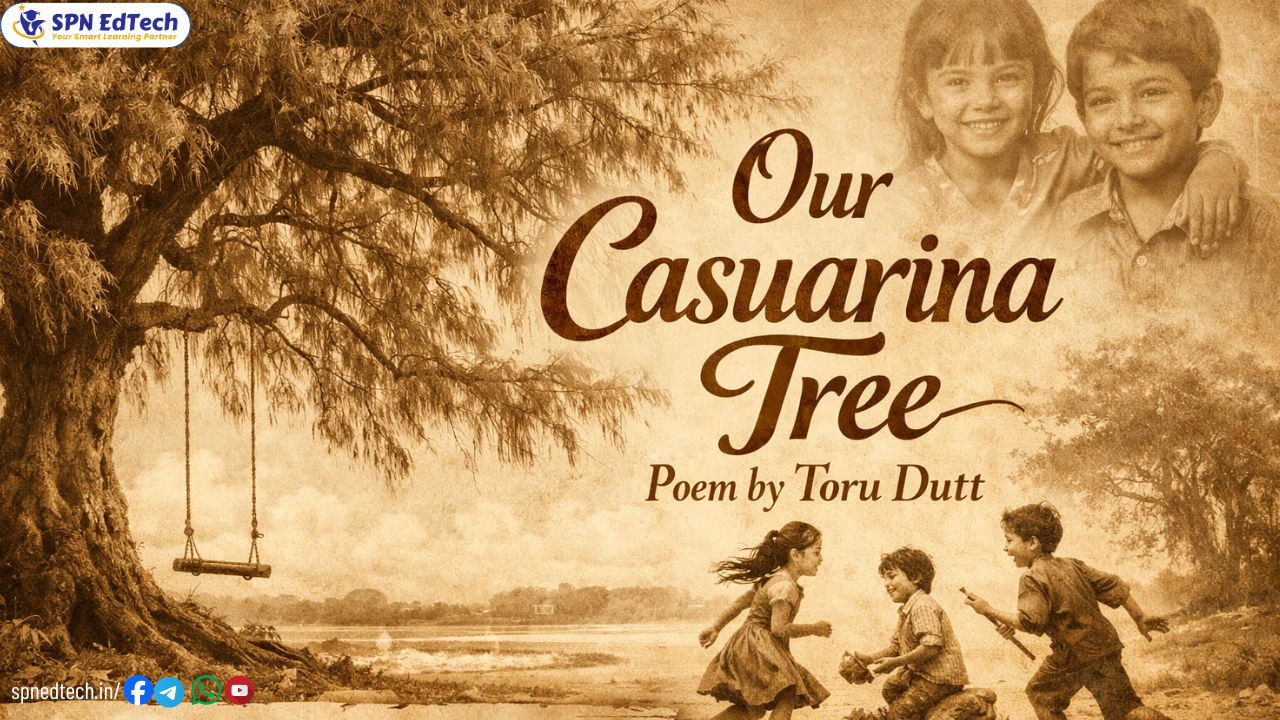
Introduction: "Our Casuarina Tree" is a masterpiece of Indian English poetry. Written by Toru Dutt, it is a deeply personal and nostalgic poem that blends the beauty of nature with the tragic memories of the poet's lost siblings.
- 📖 Chapter Name: Our Casuarina Tree
- ✍️ Poet: Toru Dutt (The Keats of Indo-Anglian Literature)
- 🏫 Class: 12 (Semester-3)
- 📌 Genre: Nostalgic Lyric Poem
🟢 2. Author Introduction
Toru Dutt (1856–1877) was a pioneering Indian poet who wrote in English and French. She is often called the "Keats of India" because of her sensitive imagery and her untimely death at the age of 21. Her work often explored Indian myths and personal loss.
Famous Works: Ancient Ballads and Legends of Hindustan and A Sheaf Gleaned in French Fields.
Style: Her writing is characterized by romanticism, vivid descriptions of nature, and a profound sense of melancholy and longing.
🟢 3. Full Summary (Poem Explanation)
Stanza 1: The poem begins with a majestic description of the Casuarina tree. A massive creeper winds around the tree like a giant python, leaving deep scars. Despite this, the tree stands tall and strong, covered in crimson (red) flowers where birds and bees gather.
Stanza 2: The poet describes her mornings. When she opens her window, she often sees a "gray baboon" sitting statue-like on the tree's crest while its young ones play in the lower branches. The garden is filled with the song of kokilas (cuckoos) and the sight of white water-lilies in the pond that look like "snow enmassed."
Stanza 3: The tone shifts from nature to deep emotion. The tree is not dear to her just for its beauty, but because she played under it with her siblings (Abju and Aru), who are now dead. The tree becomes a symbol of her lost childhood and the loved ones she misses dearly.
Stanza 4: Even when Toru Dutt was far away in France or Italy, she could hear the "dirge-like murmur" (sad song) of the tree in her heart. This shows that her connection to the tree was spiritual and crossed geographical boundaries.
Stanza 5: In the final stanza, the poet wishes to immortalize the tree through her verse, much like Wordsworth did for the trees of Borrowdale. She prays that Love may protect the tree from the "oblivion's curse" (being forgotten).
🟢 4. Theme / Central Idea
- Nostalgia and Memory: The central theme is the poet’s longing for her childhood and the intense memory of her dead siblings.
- Nature as a Healer: The tree acts as a bridge between the past and the present, and between the living and the dead.
- Immortality of Art: The poet believes that while humans die, poetry can make a physical object (like the tree) immortal.
- Transcendence: The idea that emotional connections are not limited by distance or time.
🟢 5. Important Explanation
"Unknown, yet well-known to the eye of faith!"
Meaning: This line explains that although the Casuarina tree is physically in India and "unknown" to the people of Europe, it is perfectly visible to the poet through her "eye of faith" or her spiritual memory. Her love for her home and her siblings makes the tree a constant presence in her mind.
Exam Point: The "dirge-like murmur" refers to the sound of the wind in the leaves, which the poet perceives as the tree mourning the death of her siblings.
🟢 6. Character Sketch (Key Figures)
1. The Poet (Toru Dutt)
- Nature: Sensitive, deeply nostalgic, and spiritually connected to her roots.
- Role: The speaker and the emotional anchor of the poem.
- Importance: She bridges the gap between the physical world (the tree in India) and her current reality in Europe, turning a natural object into a monument of love.
2. The Siblings (Abju and Aru)
- Nature: Innocent and "sweet companions" who are now deceased.
- Role: They exist in the poem through the poet's memory.
- Importance: They are the soul of the poem; the Casuarina tree is "dear" to the poet only because it was shared with them. They represent the tragic loss that fuels the poem’s melancholy.
3. The Casuarina Tree (Personified)
- Nature: Majestic, "Giant," and resilient, standing strong despite being scarred by the creeper.
- Role: The central protagonist of the poem.
- Importance: It serves as a living witness to the poet's childhood and a "vessel" for her memories. It is personified as a being that mourns (lamenting) the absence of the poet and her family.
🟢 7. Symbolism (Metaphor/Simile)
- Simile: "Like a huge Python, winding round and round" — The creeper is compared to a snake, suggesting both beauty and a suffocating grip.
- Metaphor: The tree is a metaphor for the poet's family and her deep-rooted Indian heritage.
- Imagery: The "gray baboon," the "crimson clusters," and "snow enmassed" lilies create a vivid visual picture of a tropical Indian garden.
- Personification: The tree is described as "wearing" the scarf of the creeper and "lamenting" the poet's absence.
🟢 8. MCQ Section (20 Questions)
- 1. What is the creeper compared to in the first stanza?
(a) A long rope (b) A giant python (c) A silver chain (d) A flowing river
Ans: (b) A giant python - 2. What color are the flowers of the Casuarina tree?
(a) Yellow (b) White (c) Crimson (d) Blue
Ans: (c) Crimson - 3. Who sits like a statue on the top of the tree?
(a) A peacock (b) A gray baboon (c) A nightingale (d) An eagle
Ans: (b) A gray baboon - 4. Which bird hails the day in the poem?
(a) Sparrow (b) Parrot (c) Kokila (d) Crow
Ans: (c) Kokila - 5. The water-lilies in the pond look like:
(a) Falling stars (b) Snow enmassed (c) White pearls (d) Floating clouds
Ans: (b) Snow enmassed - 6. Why is the tree dear to the poet’s soul?
(a) For its height (b) For its fruit (c) For the memories of her siblings (d) For its wood
Ans: (c) For the memories of her siblings - 7. The siblings mentioned in the poem are:
(a) Ram and Laxman (b) Abju and Aru (c) John and Mary (d) Rahul and Anjali
Ans: (b) Abju and Aru - 8. Where was the poet when she heard the tree’s "lament"?
(a) In India (b) In America (c) In France or Italy (d) In Africa
Ans: (c) In France or Italy - 9. Toru Dutt is often compared to which English poet?
(a) John Keats (b) P.B. Shelley (c) Lord Byron (d) William Wordsworth
Ans: (a) John Keats - 10. What does the "dirge-like murmur" signify?
(a) Happy news (b) A funeral song or mourning (c) The sound of rain (d) A wedding song
Ans: (b) A funeral song or mourning - 11. The tree is called a "Giant" because:
(a) It is scary (b) It is very large and strong (c) It eats birds (d) It is magical
Ans: (b) It is very large and strong - 12. "Oblivion’s curse" means:
(a) A magic spell (b) Being forgotten forever (c) A physical disease (d) A dark forest
Ans: (b) Being forgotten forever - 13. The "Classic Enclaves" refers to:
(a) Ancient India (b) Europe (c) Her garden (d) The mountains
Ans: (b) Europe - 14. The poem ends with a prayer for the tree to be:
(a) Cut down (b) Watered daily (c) Immortalized/Saved from oblivion (d) Painted red
Ans: (c) Immortalized/Saved from oblivion - 15. What "eye" can see the tree from far away?
(a) The eye of science (b) The eye of faith (c) The eye of a hawk (d) The eye of a storm
Ans: (b) The eye of faith - 16. The tree "wears" the creeper like a:
(a) Scarf (b) Crown (c) Belt (d) Ring
Ans: (a) Scarf - 17. How many stanzas are in the poem?
(a) Three (b) Four (c) Five (d) Six
Ans: (c) Five - 18. What was the poet's age when she died?
(a) 18 (b) 21 (c) 30 (d) 45
Ans: (b) 21 - 19. The tone of the poem is:
(a) Angry (b) Humorous (c) Melancholic and Nostalgic (d) Sarcastic
Ans: (c) Melancholic and Nostalgic - 20. Who are the "sweet companions" mentioned?
(a) The birds (b) The baboons (c) Her dead siblings (d) Her teachers
Ans: (c) Her dead siblings
🟢 9. One-Line Revision
- ✅ The tree is a giant, standing strong despite being wrapped by a python-like creeper.
- ✅ It serves as a living memory of Toru Dutt's siblings, Abju and Aru.
- ✅ The poet uses vivid imagery (baboons, kokilas, lilies) to describe the Indian landscape.
- ✅ The poem connects the poet's physical presence in Europe to her spiritual heart in India.
- ✅ The theme emphasizes that love and poetry can grant immortality to nature and memory.
- ✅ This is a quintessential Romantic poem blending objective beauty with subjective grief.
Study Notes PDF
Download this article for offline study







Social Platforms