
🟢 1. Basic Info Section
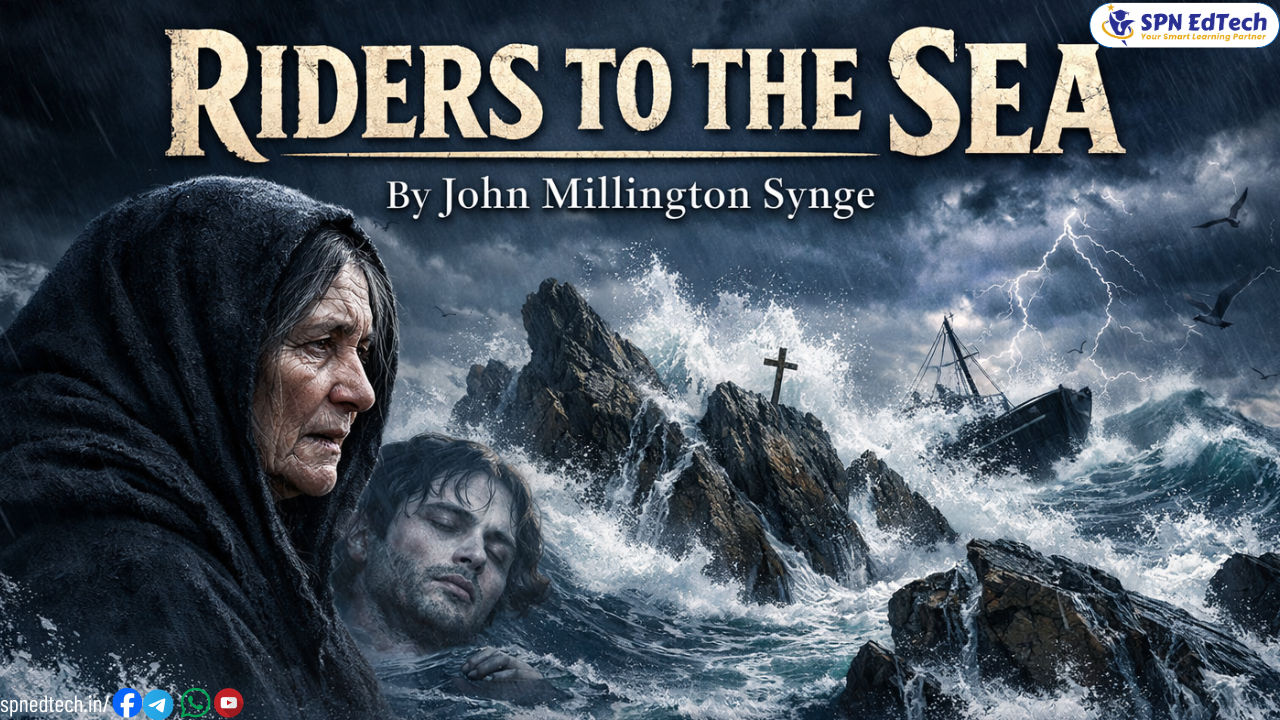
Short Intro: Riders to the Sea is a one-act tragedy written by Irish playwright J.M. Synge. It is considered a masterpiece of the Irish Literary Renaissance, capturing the relentless struggle between humanity and the uncontrollable forces of nature.
📖 Play Name: Riders to the Sea
✍️ Author: John Millington Synge
🏫 Class :12 (Semester-3)
📌 Genre: Tragedy / One-Act Play
🟢 2. Author Introduction
John Millington Synge (1871–1909) was a leading figure in the Irish Literary Revival and a co-founder of the Abbey Theatre. He is famous for capturing the authentic poetic dialect of the Aran Islands. His writing style is characterized by "Hiberno-English," a blend of English vocabulary and Gaelic syntax. His most famous works include The Playboy of the Western World and In the Wicklow Mountains. Synge's plays often depict the harsh realities of rural Irish life, blending realism with deep symbolism.
🟢 3. Full Summary (VERY IMPORTANT ⭐)
The play is set in a small cottage on the Aran Islands, off the west coast of Ireland. The story revolves around Maurya, an elderly woman who has lost her husband and five sons to the sea. At the beginning of the play, her daughters, Cathleen and Nora, receive a bundle of clothes from a drowned man found in Donegal, fearing they belong to their brother Michael, the sixth son.
Maurya’s last surviving son, Bartley, prepares to sail to Connemara to sell horses at a fair. Despite Maurya's pleas and the stormy weather, Bartley insists on going. Maurya fails to give him her blessing as he departs. Later, she has a terrifying vision of Michael’s ghost riding behind Bartley. Soon after, the news arrives that Bartley has been knocked off his horse into the sea and drowned.
The play ends with Maurya’s profound resignation. Having lost all her men to the sea, she no longer has to fear the tide. She accepts her fate with a haunting calmness, stating, "No man at all can be living for ever, and we must be satisfied."
🟢 4. Theme / Central Idea
- Man vs. Nature: The primary conflict is between the islanders and the sea. The sea is portrayed as an unstoppable, indifferent pagan god that claims human lives.
- Fatalism and Resignation: The characters exhibit a sense of "Stoicism." They know they cannot win against nature, so they eventually accept their suffering.
- The Cycle of Life and Death: The play emphasizes that death is an inevitable part of the islanders' existence.
🟢 5. Important Explanation
The Vision of the Two Riders: Maurya sees Bartley on a red mare followed by Michael on a grey pony. Since Michael is already dead, this vision symbolizes that the "dead" are coming to claim the "living." This is the climax of the supernatural elements in the play.
The Use of Holy Water: At the end, Maurya sprinkles holy water on Michael's clothes and Bartley’s body. This represents the blend of Christian rituals and pagan fears in the islanders' lives.
🟢 6. Character Sketch
The characters in Riders to the Sea are deeply symbolic, representing the struggle of a community living on the edge of existence.
MAURYA
Nature: Resilient, spiritual, and eventually stoic. She is the embodiment of the "suffering mother" archetype.
Role: The central protagonist whose life is defined by her tragic relationship with the sea.
Importance: Maurya represents the struggle of humanity against fate. Her transition from frantic anxiety about Bartley to a state of "heroic resignation" is the play's emotional core. She provides the final philosophical resolution: that death is a release from the terror of the tide.
BARTLEY
Nature: Determined, practical, and courageous. He possesses a youthful stubbornness driven by survival.
Role: The last surviving son and the family's sole provider.
Importance: Bartley symbolizes the "active" victim. Unlike the women who wait, he must confront the waves to sustain the family. His death highlights the harsh reality—that for these islanders, risking death is the only way to live.
MICHAEL
Nature: Invisible but omnipresent; a ghostly figure of the family's past losses.
Role: The "missing" son whose death is confirmed through his hand-knitted clothes.
Importance: Though Michael never appears alive, he drives the plot. As a "ghost" on the grey pony in Maurya’s vision, he acts as a supernatural omen that calls Bartley to the grave, linking the dead with the living.
CATHLEEN
Nature: Mature, organized, and protective. She is the "manager" of the domestic sphere.
Role: The elder daughter who handles the household responsibilities and protects her mother.
Importance: Cathleen represents the bridge between Maurya’s traditional grief and practical survival. She is the shield that tries to keep the family's sanity intact while facing continuous tragedy.
NORA
Nature: Observant, helpful, and sensitive. She is younger and more vulnerable than her sister.
Role: The younger daughter who brings information from the outside world (via the Priest).
Importance: Nora provides the "eyes and ears" for the audience. Her recognition of the dropped stitches in Michael's stocking is the definitive proof that brings the family's hope to an end.
🟢 7. Symbolism
- The Sea: A symbol of both life (sustenance) and death (destruction).
- The White Boards: Meant for Michael’s coffin, they end up being used for Bartley, symbolizing the inevitable fate of the men in the family.
- The Red Mare and Grey Pony: Represent the colors of passion/life and death/ghostliness.
🟢 8. MCQ Section (MOST IMPORTANT)
(a) W.B. Yeats (b) J.M. Synge (c) Samuel Beckett (d) G.B. Shaw
Ans: (b) J.M. Synge
(a) Dublin (b) Aran Islands (c) London (d) Donegal
Ans: (b) Aran Islands
(a) 4 (b) 5 (c) 6 (d) 2
Ans: (c) 6
(a) Sheep (b) Cows (c) Horses (d) Fishing Nets
Ans: (c) Horses
(a) Nora (b) Maurya (c) Cathleen (d) Mary
Ans: (c) Cathleen
(a) Illness (b) War (c) Drowning (d) Old age
Ans: (c) Drowning
(a) A ring (b) A stocking (c) A shirt (d) A letter
Ans: (b) A stocking
(a) Red (b) Black (c) Grey (d) White
Ans: (c) Grey
(a) Bread (b) His blessing (c) Money (d) A coat
Ans: (b) His blessing
(a) Happily (b) For ever (c) Without the sea (d) In peace
Ans: (b) For ever
(a) A table (b) Bartley's coffin (c) Fixing the boat (d) A door
Ans: (b) Bartley's coffin
(a) Angry (b) Resigned/Calm (c) Joyful (d) Confused
Ans: (b) Resigned/Calm
(a) Connemara (b) Donegal (c) Galway (d) Kerry
Ans: (b) Donegal
(a) Comedy (b) One-act Tragedy (c) Satire (d) Farce
Ans: (b) One-act Tragedy
(a) Bartley (b) A young priest (c) A neighbor (d) Nora
Ans: (b) A young priest
(a) Sunny (b) Windy and stormy (c) Snowing (d) Calm
Ans: (b) Windy and stormy
(a) Three (b) Four (c) Five (d) Six
Ans: (b) Four
(a) Farming (b) The sea/Fishing (c) Mining (d) Teaching
Ans: (b) The sea/Fishing
(a) Michael (b) Bartley (c) Stephen (d) Patch
Ans: (b) Bartley
(a) Friend (b) Antagonist (Enemy) (c) Minor character (d) Background noise
Ans: (b) Antagonist (Enemy)
🟢 9. One-Line Revision
- 🔹 Author: J.M. Synge, a key figure in the Irish Literary Revival.
- 🔹 Setting: Aran Islands, emphasizing a life of hardship and sea-dependence.
- 🔹 Tragic Heroine: Maurya, who loses her husband and all six sons to the sea.
- 🔹 Climax: Maurya’s vision of her dead son Michael following Bartley.
- 🔹 Symbolism: The sea represents an indifferent, destructive force of nature.
- 🔹 Conclusion: Maurya finds peace only when the sea has nothing left to take from her.
Study Notes PDF
Download this article for offline study







Social Platforms