
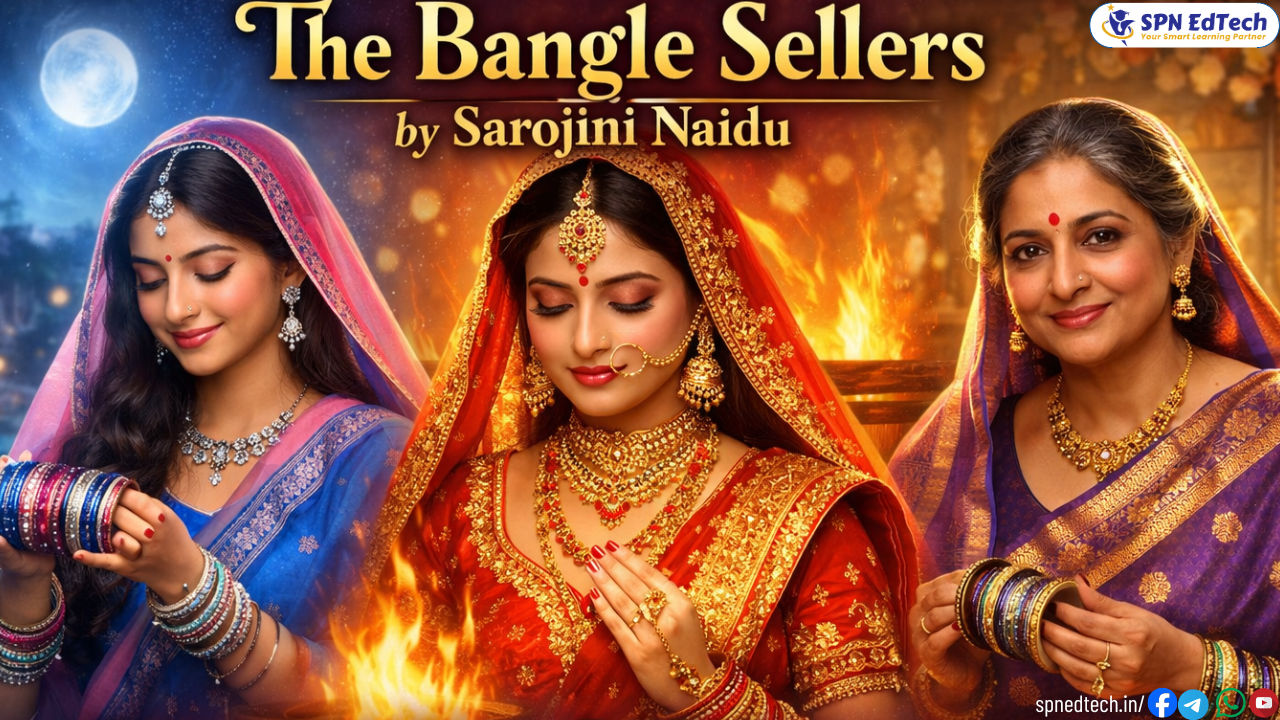
1. Basic Info Section
Introduction: "The Bangle Sellers" is a vibrant and lyrical poem that celebrates the different stages of an Indian woman's life through the colorful bangles she wears. It captures the essence of Indian tradition and the rhythmic beauty of social life in rural India.
- 📖 Chapter Name: The Bangle Sellers
- ✍️ Poet: Sarojini Naidu
- 🏫 Class: 11 (Semester-1)
- 📌 Genre: Lyric Poetry
2. Author Introduction
Sarojini Naidu (1879–1949), known as the "Nightingale of India," was a distinguished poet and a prominent leader in India's independence movement. Her poetry is celebrated for its lush imagery, melodic rhythm, and deep connection to Indian folklore and culture. Her famous works include The Golden Threshold, The Bird of Time, and The Broken Wing. Her writing style is characterized by the use of vivid sensory details and a lyrical quality that makes her verses flow like music.
3. Full Summary (Stanza-wise)
The poem is narrated by a group of bangle sellers who are traveling to a temple fair to sell their wares. They describe their bangles as "rainbow-tinted circles of light" that represent the happiness and radiant lives of women.
Stanza 1: The bangle sellers introduce themselves and their product. They carry loads of bangles to the temple fair, calling them "lustrous tokens" for happy daughters and happy wives.
Stanza 2: Focuses on the Maiden (unmarried girl). She wears silver and blue bangles like the mountain mist, pink ones like buds on a woodland stream, and glowing green ones like newborn leaves. These colors represent purity and freshness.
Stanza 3: Focuses on the Bride. She wears yellow bangles like "fields of sun-lit corn" and red/orange ones like the "flame of her marriage fire." The colors represent her transition into a new life, filled with passion and longing.
Stanza 4: Focuses on the Middle-Aged Woman. She wears purple and gold-flecked grey bangles. These colors symbolize her maturity, her role as a mother, and the pride she takes in having served her household with love and devotion.
4. Theme / Central Idea
The Stages of Womanhood: The central theme is the celebration of the various stages of an Indian woman's life. Each color of the bangle corresponds to a specific phase—from the innocence of childhood to the passion of marriage and the wisdom of motherhood.
Cultural Heritage: The poem also highlights the richness of Indian traditions, temple fairs, and the social significance of ornaments in expressing identity and joy.
5. Important Explanation
"Rainbow-tinted circles of light": This is a beautiful metaphor for bangles. It suggests they are not just glass objects but radiant circles that catch the light, reflecting the joy and diverse "colors" of a woman's life.
"Lustrous tokens of radiant lives": The poet emphasizes that bangles are symbols (tokens) of the happiness and brightness (radiant lives) of the women who wear them.
"Sun-lit corn" vs "Marriage fire": While both are shades of yellow/red, sun-lit corn represents the beauty of the wedding morning, while marriage fire represents the passion and sacred nature of the union.
6. Character Sketch (The Bangle Sellers)
Nature: They are hardworking, cheerful, and deeply observant. They act as the narrators of the poem.
Role: They serve as links between the different stages of society. They do not just sell glass; they sell symbols of happiness and tradition.
Importance: Through their eyes, we see the entire lifecycle of a woman. They represent the vibrant, traditional workforce of rural India.
7. Symbolism (Poem)
- Metaphor: "Rainbow-tinted circles of light" for bangles.
- Simile: "Silver and blue as the mountain mist," "Some are like fields of sun-lit corn."
- Imagery: The poem is rich in visual imagery (colors like silver, blue, pink, green, yellow, red, purple) and auditory imagery (the tinkling of bangles).
- Alliteration: "Happy daughters and happy wives."
8. MCQ Section (MOST IMPORTANT)
(a) A young bride (b) The poet herself (c) The Bangle Sellers (d) A middle-aged mother
Ans: (c) The Bangle Sellers
(a) To a wedding (b) To a temple fair (c) To a king's palace (d) To a woodland stream
Ans: (b) To a temple fair
(a) Heavy iron rings (b) Rainbow-tinted circles of light (c) Broken pieces of glass (d) Dark circles of sorrow
Ans: (b) Rainbow-tinted circles of light
(a) Purple and gold (b) Yellow and red (c) Silver and blue (d) Grey and black
Ans: (c) Silver and blue
(a) Death (b) Maturity (c) The bloom of a maiden (d) Marriage fire
Ans: (c) The bloom of a maiden
(a) A mother (b) A maiden (c) A bride (d) An old woman
Ans: (c) A bride
(a) Anger (b) The flame of a marriage fire (c) The mountain mist (d) Peaceful old age
Ans: (b) The flame of a marriage fire
(a) Green and Blue (b) Silver and Pink (c) Purple and gold-flecked grey (d) Yellow and Orange
Ans: (c) Purple and gold-flecked grey
(a) Traveling the world (b) Serving her household with love (c) Fighting in wars (d) Selling bangles
Ans: (b) Serving her household with love
(a) The Sun (b) The Moon (c) The Household Gods (d) The Bangle Sellers
Ans: (c) The Household Gods
(a) Metaphor (b) Simile (c) Personification (d) Hyperbole
Ans: (b) Simile
(a) Dull (b) Broken (c) Shining (d) Expensive
Ans: (c) Shining
(a) Signs of wealth (b) Symbols of happiness (c) Burden of women (d) Simple toys
Ans: (b) Symbols of happiness
(a) Maidenhood (b) Childhood (infancy) (c) Marriage (d) Middle age
Ans: (b) Childhood (infancy)
(a) The sellers (b) The bride (c) The priest (d) The mountain
Ans: (b) The bride
(a) Mourning (b) Maturity and journey through life (c) New beginnings (d) Wealth only
Ans: (b) Maturity and journey through life
(a) The Iron Lady (b) The Nightingale of India (c) The Lady with the Lamp (d) The Poet of Nature
Ans: (b) The Nightingale of India
(a) AABBCC (b) ABABCC (c) AABB (d) ABCABC
Ans: (a) AABBCC
(a) Melancholy (b) Angry (c) Joyful and Celebratory (d) Sarcastic
Ans: (c) Joyful and Celebratory
(a) The Bride (b) The Maiden (c) The Middle-aged mother (d) The Bangle seller
Ans: (c) The Middle-aged mother
9. One-Line Revision
- ⭐ Bangle Sellers: Narrators who bring joy and tradition to the temple fair.
- ⭐ Maiden's Bangles: Silver, blue, and pink, symbolizing purity and new life.
- ⭐ Bride's Bangles: Yellow and fiery red, representing the passion and transition of marriage.
- ⭐ Matriarch's Bangles: Purple and gold-flecked grey, symbolizing maturity and domestic wisdom.
- ⭐ Core Theme: The patriarchal and traditional lifecycle of an Indian woman expressed through ornaments.
- ⭐ Poetic Style: Lyrical, rhythmic, and rich in color-based imagery and similes.
Study Notes PDF
Download this article for offline study







Social Platforms