
🟢 1. Basic Info Section
Introduction: 'The Model Millionaire' is a delightful short story by Oscar Wilde that explores the themes of generosity, appearances, and the true meaning of wealth. It tells the story of a young man whose kindness towards a beggar leads to an unexpected reward.
- 📖 Chapter Name: The Model Millionaire
- ✍️ Author: Oscar Wilde
- 🏫 Class : 11 (Semester-1)
- 📌 Genre: Short Story / Satire / Romantic Fiction
🟢 2. Author Introduction
Oscar Wilde (1854–1900) was an Irish poet and playwright, famous for his wit and flamboyant style. He was a leading figure in the Aesthetic Movement, believing in "Art for Art's sake." His famous works include The Picture of Dorian Gray and The Importance of Being Earnest. His writing style is characterized by sparkling epigrams, sharp social satire, and a deep understanding of human nature hidden beneath a layer of humor.
🟢 3. Full Summary (VERY IMPORTANT ⭐)
Hughie Erskine is a charming and handsome young man, but he is financially unsuccessful. He is in love with Laura Merton, but her father, a retired Colonel, demands that Hughie must have ten thousand pounds of his own before they can marry. One day, Hughie visits his friend Alan Trevor, a painter, who is finishing a portrait of a beggar-man. The beggar looks miserable, tattered, and weary.
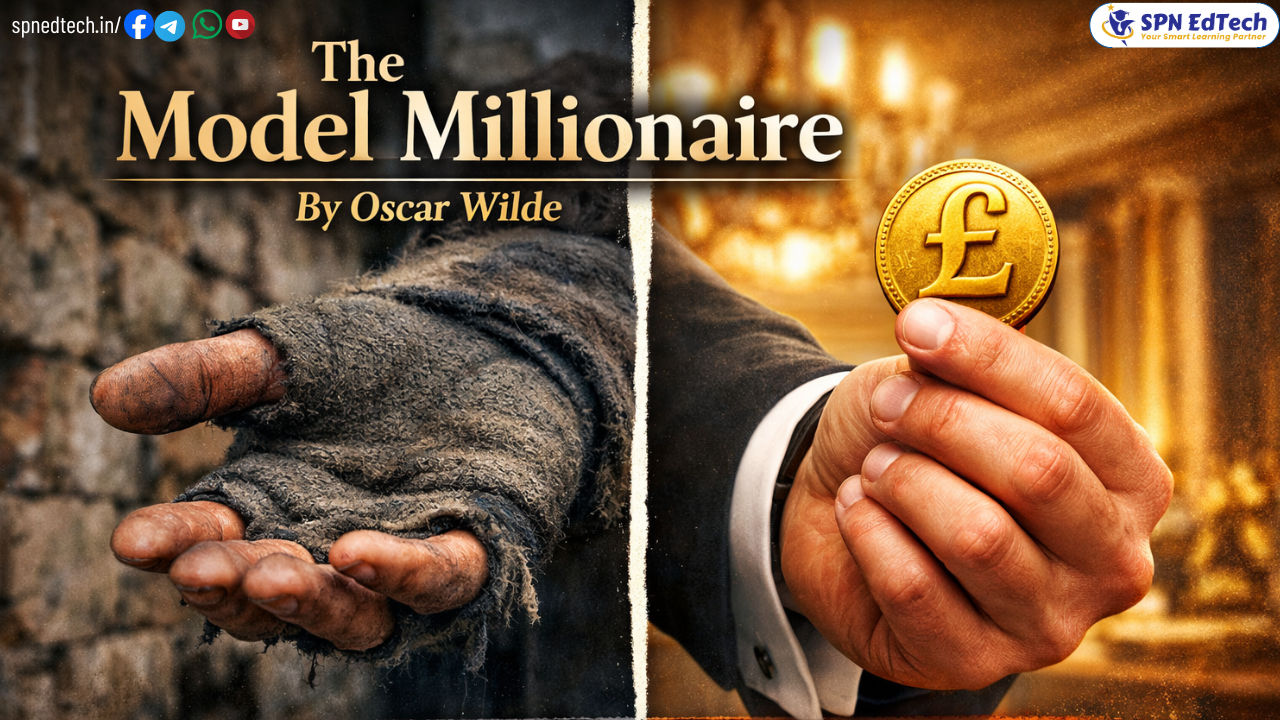
Feeling deep pity for the old man, Hughie searches his pockets and gives his last sovereign (gold coin) to the beggar, even though it means he will have no money for himself. Later, Hughie learns from Alan that the "beggar" was actually Baron Hausberg, one of the richest men in Europe, who had commissioned the portrait for fun. Hughie is embarrassed, thinking he has insulted a millionaire.
However, the next day, a messenger from Baron Hausberg arrives. Instead of being angry, the Baron is touched by Hughie’s genuine kindness. He sends Hughie a check for ten thousand pounds as a wedding gift. Hughie and Laura get married, and the Baron attends the wedding, proving that a "model millionaire" is rarer than a "millionaire model."
🟢 4. Theme / Central Idea
Main Message: The story emphasizes that character is more important than wealth. It challenges the Victorian social standards where a person's worth was measured solely by their bank balance. The central idea is "Charity begins at home, but true kindness is rewarded." It also highlights the contrast between appearance and reality; a man who looks like a beggar can be a millionaire, and a man who has no money can have a heart of gold.
🟢 5. Important Explanation
Key Event: The Act of Giving
The most crucial moment is when Hughie gives his last sovereign to the beggar. This act is "impulsive" but "sincere." It shows that Hughie doesn't care about his own struggle when he sees someone else in seemingly greater need. This pure-heartedness is what distinguishes him from the materialistic society around him.
Useful Points for Exam:
- The irony of the title: "Model Millionaire" vs. "Millionaire Model."
- The role of Alan Trevor as the bridge between Hughie and the Baron.
- The Colonel’s condition as a plot device to create conflict.
🟢 6. Character Sketch
1. Hughie Erskine: The protagonist. He is handsome, kind, but "useless" in business. He represents pure, unselfish kindness. His lack of intellectual brilliance is compensated by his generous spirit.
2. Baron Hausberg: A powerful millionaire who enjoys eccentric hobbies. He values sincerity over social status. By rewarding Hughie, he acts as a 'Deus ex machina' (a character who solves the problems of the plot).
3. Alan Trevor: An artist and Hughie's friend. He is a hard worker who appreciates beauty and realism. He provides the comic relief and the revelation of the Baron's identity.
4. Laura Merton: Hughie’s fiancée. She is supportive and loves Hughie for who he is, not for his money.
🟢 7. Symbolism & Literary Devices
Oscar Wilde uses several symbols and literary techniques to convey the deeper meaning of the story:
- The Sovereign (Gold Coin): This represents Hughie's entire wealth but also his "heart of gold." Giving it away symbolizes self-sacrifice and the idea that true generosity is measured by what one gives up, not just what one gives.
- The Beggar's Rags: Symbolizes the Appearance vs. Reality theme. The rags hide a millionaire, suggesting that social status is often just a costume and shouldn't define how we treat others.
- The Canvas/Painting: Represents the artist’s perspective. While Alan Trevor sees the beggar as "aesthetic" or "picturesque," Hughie sees a human being in pain. This highlights the difference between artistic detachment and human empathy.
- Irony: The central device of the story. It is ironic that the man Hughie thought was a "model" (a person posing for money) turned out to be a "model millionaire" (a person who is a perfect example of wealth used well).
- Juxtaposition: Wilde places the "useless" but kind Hughie against the "useful" but cold standards of the Victorian banking world to show that emotional intelligence is superior to financial greed.
🟢 8. MCQ Section (MOST IMPORTANT)
- 1. Who is the author of 'The Model Millionaire'?
(a) Charles Dickens (b) Oscar Wilde (c) Leo Tolstoy (d) Mark Twain
Ans: (b) Oscar Wilde - 2. What was the profession of Hughie Erskine?
(a) Lawyer (b) Doctor (c) He had no fixed profession (d) Artist
Ans: (c) He had no fixed profession - 3. Who was the girl Hughie loved?
(a) Mary (b) Laura Merton (c) Elizabeth (d) Sophia
Ans: (b) Laura Merton - 4. How much money did the Colonel demand from Hughie?
(a) £5,000 (b) £10,000 (c) £20,000 (d) £1,000
Ans: (b) £10,000 - 5. What was Alan Trevor's profession?
(a) Banker (b) Painter (c) Writer (d) Soldier
Ans: (b) Painter - 6. What was the beggar-man actually?
(a) A real beggar (b) A thief (c) Baron Hausberg (d) A spy
Ans: (c) Baron Hausberg - 7. What coin did Hughie give to the beggar?
(a) A penny (b) A shilling (c) A sovereign (d) A dollar
Ans: (c) A sovereign - 8. Baron Hausberg was one of the richest men in:
(a) London (b) Paris (c) Europe (d) The World
Ans: (c) Europe - 9. Why did the Baron send a check to Hughie?
(a) As a loan (b) As a wedding present (c) To buy a painting (d) By mistake
Ans: (b) As a wedding present - 10. What did the messenger bring for Hughie?
(a) A letter (b) A painting (c) A sealed envelope with a check (d) A bag of gold
Ans: (c) A sealed envelope with a check - 11. What was written on the outside of the envelope?
(a) For Hughie's help (b) A wedding present to Hughie and Laura (c) From a beggar (d) Confidential
Ans: (b) A wedding present to Hughie and Laura - 12. According to Alan, an artist's best models are:
(a) Rich people (b) Beautiful people (c) Real beggars (d) Professional models
Ans: (c) Real beggars - 13. How did Hughie feel when he found out the beggar was a Baron?
(a) Happy (b) Dismayed/Embarrassed (c) Angry (d) Indifferent
Ans: (b) Dismayed/Embarrassed - 14. The Baron was a great patron of:
(a) Science (b) War (c) Art (d) Music
Ans: (c) Art - 15. What was the relationship between Alan and Hughie?
(a) Brothers (b) Enemies (c) Friends (d) Father and Son
Ans: (c) Friends - 16. Where did Alan Trevor meet the Baron?
(a) In a park (b) At a party (c) In his studio (d) In a bank
Ans: (c) In his studio - 17. Hughie’s appearance was:
(a) Ugly (b) Very handsome (c) Average (d) Old
Ans: (b) Very handsome - 18. What was the Colonel's rank?
(a) Retired Colonel (b) Active General (c) Major (d) Captain
Ans: (a) Retired Colonel - 19. The story is a satire on:
(a) Religion (b) Wealth and Social Class (c) Education (d) Nature
Ans: (b) Wealth and Social Class - 20. Who attended Hughie’s wedding?
(a) Only Alan (b) Baron Hausberg (c) No one (d) The King
Ans: (b) Baron Hausberg
🟢 9. One-Line Revision
- 🔹 Hughie Erskine is a kind but poor man in love with Laura Merton.
- 🔹 The Colonel sets a condition of £10,000 for their marriage.
- 🔹 Hughie gives his last gold coin to a "beggar" in Alan Trevor's studio.
- 🔹 The beggar is actually the wealthy Baron Hausberg in disguise.
- 🔹 Baron Hausberg rewards Hughie’s kindness with the required £10,000.
- 🔹 The story proves that "Millionaire models are rare, but model millionaires are rarer."
Study Notes PDF
Download this article for offline study







Social Platforms