
1. Basic Info Section _________________________________________________
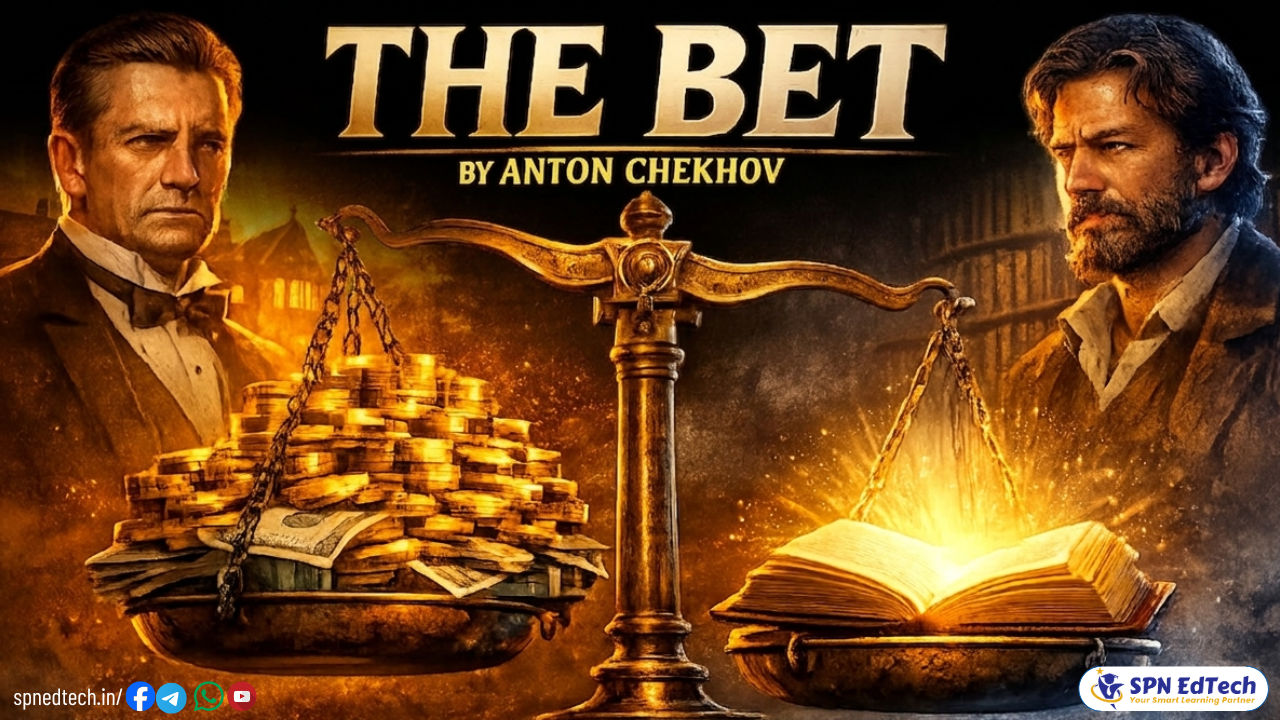
Anton Chekhov's "The Bet" is a profound philosophical short story that questions the value of life, freedom, and the futility of material wealth. It explores a high-stakes wager that tests the limits of human endurance and intellect.
- 📖 Chapter Name: The Bet
- ✍️ Author: Anton Chekhov
- 🏫 Class : 12 (Semester-3)
- 📌 Genre: Philosophical Short Story
2. Author Introduction _________________________________________________
Anton Chekhov (1860–1904): A preeminent Russian playwright and short-story writer, considered one of the greatest masters of the modern short story. Though a physician by profession, his literary contributions are monumental.
Famous Works: His major plays include 'The Cherry Orchard', 'Uncle Vanya', 'The Three Sisters', and 'The Seagull'.
Writing Style: Chekhov is known for his economy of language, psychological depth, and his "show, don't tell" technique. He often focused on the mundane aspects of life to reveal profound existential truths.
3. Full Summary _________________________________________________
The story opens on a dark autumn night as an old banker recalls a party he hosted fifteen years ago. During that party, a heated debate arose regarding the death penalty versus life imprisonment. The banker argued that capital punishment is more moral because it kills a person instantly, whereas life imprisonment kills by degrees. A young lawyer disagreed, stating that to live in any way is better than not living at all.
The banker, in a fit of ego, wagered two million rubles that the lawyer could not stay in solitary confinement for even five years. The lawyer, impulsive and idealistic, raised the stakes to fifteen years. The conditions were strict: no human contact, no verbal communication, and no news from the outside world. He was allowed books, musical instruments, wine, and writing materials.
Over the fifteen years, the lawyer undergoes a massive transformation. In the first year, he suffers from loneliness but finds solace in piano and light novels. By the fifth year, he studies languages, philosophy, and history. Eventually, he masters six languages. In the final years, he turns to the Bible and various religious texts, seeking the meaning of existence.
As the fifteen-year term nears its end, the banker is now broke due to poor investments. Realizing that paying the two million rubles will leave him bankrupt, he decides to murder the lawyer. However, upon entering the cell, he finds the lawyer emaciated and asleep, with a letter on the table. The letter explains that through his studies, the lawyer has learned to despise worldly goods and freedom. To prove his disdain, he leaves five minutes before the deadline, forfeiting the money. The banker is left feeling a deep self-contempt.
4. Theme / Central Idea _________________________________________________
The central theme of the story is Materialism vs. Spiritual Enlightenment. It critiques the obsession with money and social status.
- The Illusion of Freedom: The lawyer discovers that true freedom is found within the mind and through knowledge, not through physical movement or social interaction.
- The Vanity of Life: The story highlights how humans chase temporary pleasures (wealth, beauty, power) while ignoring the inevitable reality of death.
- Moral Bankruptcy: The banker represents the moral decay that comes with the fear of losing material wealth.
5. Important Explanation _________________________________________________
The Shift in Perspective: The lawyer's journey from reading "light" fiction to "serious" philosophy and finally "divine" scripture symbolizes the stages of human intellectual and spiritual growth.
The Final Act: Leaving five minutes early is the lawyer's ultimate victory. By breaking the contract just before winning, he proves that he is no longer a slave to the system of rewards and punishments that governs the banker’s world.
Exam Note: Pay attention to the contrast between the banker’s external freedom (but internal misery) and the lawyer’s external imprisonment (but internal liberation).
6. Character Sketch _________________________________________________
1. The Banker: He is impulsive, arrogant, and defined by his wealth. Initially, he views the bet as a game. By the end, he is a desperate man willing to commit murder to save his social standing. He represents the "world" and its greed.
2. The Lawyer: Initially young and headstrong, he evolves into a skeletal, wise, and detached figure. He represents the "soul" and its quest for truth. His choice to renounce the money shows his complete transcendence over human desire.
7. Symbolism _________________________________________________
- The Two Million Rubles: Symbolizes the false value society places on material things.
- The Cell/Lodge: Represents both a tomb for the physical body and a womb for the spiritual self.
- The Letter: A symbol of the lawyer's rejection of human society and its values.
8. MCQ Section (MOST IMPORTANT) _________________________________________________
style="list-style-type: none; padding: 0;">(a) 5 years (b) 10 years (c) 15 years (d) 20 years
Ans: (c) 15 years
(a) 1 million rubles (b) 2 million rubles (c) 5 million rubles (d) 500,000 rubles
Ans: (b) 2 million rubles
(a) Violin (b) Guitar (c) Piano (d) Cello
Ans: (c) Piano
(a) Out of hatred (b) To win the bet (c) Because he was bankrupt and couldn't pay (d) To end his suffering
Ans: (c) Because he was bankrupt and couldn't pay
(a) 2 (b) 4 (c) 6 (d) 8
Ans: (c) 6
(a) On a summer evening (b) On a spring morning (c) On a dark autumn night (d) On a snowy winter day
Ans: (c) On a dark autumn night
(a) Doctor (b) Banker (c) Lawyer (d) Teacher
Ans: (c) Lawyer
(a) He asked for the money (b) He committed suicide (c) He escaped the lodge (d) He called the banker
Ans: (c) He escaped the lodge
(a) Shakespeare (b) The New Testament/Bible (c) Chemistry books (d) Travelogues
Ans: (b) The New Testament/Bible
(a) By speaking to guards (b) By writing a note in six languages (c) By singing songs (d) By translating the Bible
Ans: (b) By writing a note in six languages
(a) Books (b) Wine (c) Human contact (d) Musical instruments
Ans: (c) Human contact
(a) He felt angry (b) He felt relieved and wept (c) He laughed (d) He called the police
Ans: (b) He felt relieved and wept
(a) Life imprisonment (b) Death penalty (c) Exile (d) Fines
Ans: (b) Death penalty
(a) First year (b) Second year (c) Fifth year (d) Tenth year
Ans: (b) Fifth year
(a) It is the most important thing (b) It is a blessing (c) It is worthless and a mirage (d) It is expensive
Ans: (c) It is worthless and a mirage
(a) In his desk (b) In a fireproof safe (c) Under his pillow (d) In the library
Ans: (b) In a fireproof safe
(a) Strong and healthy (b) Skeletal and aged beyond his years (c) Happy and glowing (d) Angry and bitter
Ans: (b) Skeletal and aged beyond his years
(a) Poor (b) Extremely wealthy (c) Middle class (d) In debt
Ans: (b) Extremely wealthy
(a) 5 years (b) 10 years (c) 15 years (d) 20 years
Ans: (c) 15 years
(a) Leo Tolstoy (b) Anton Chekhov (c) Maxim Gorky (d) Fyodor Dostoevsky
Ans: (b) Anton Chekhov
9. One-Line Revision _________________________________________________
- The bet was 15 years of solitary confinement for 2 million rubles.
- The debate centered on the morality of the death penalty vs. life imprisonment.
- The lawyer spent his time mastering languages, philosophy, and religious texts.
- The banker lost his wealth over the years and contemplated murder to avoid paying.
- The lawyer renounced the money to show his disdain for material life.
- The story concludes that wisdom and spiritual peace are superior to earthly riches.
Study Notes PDF
Download this article for offline study







Social Platforms