
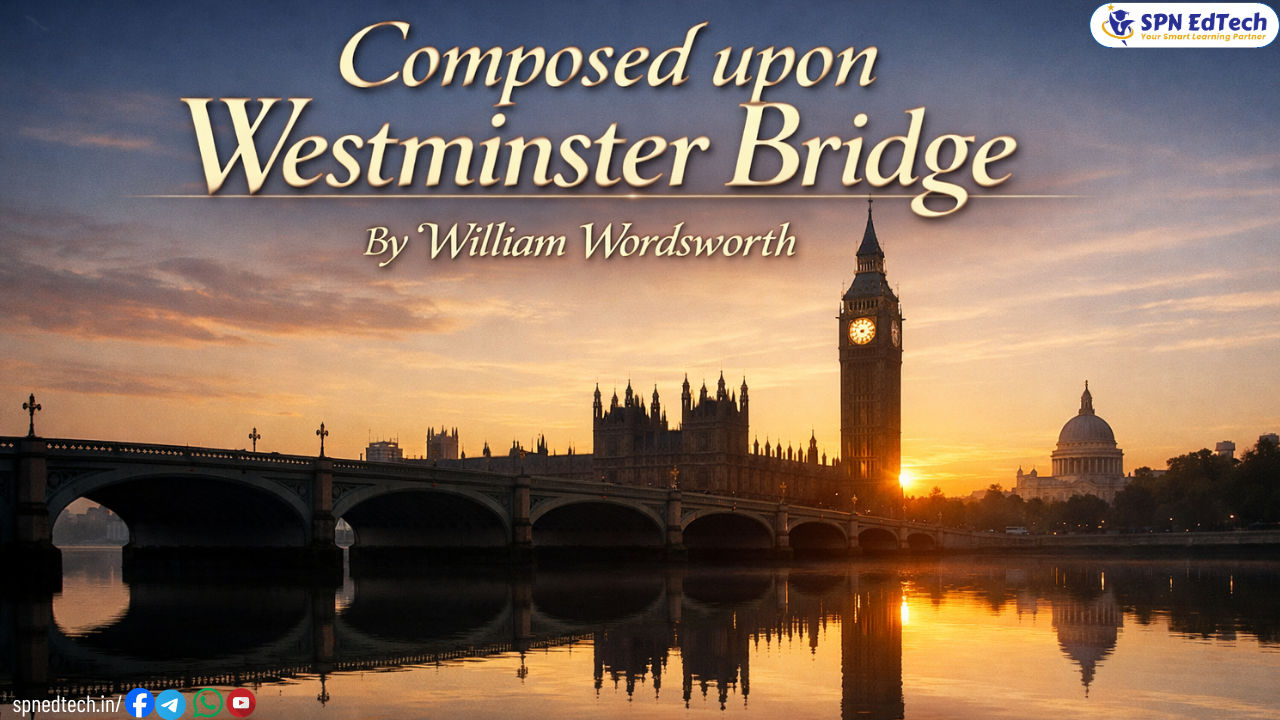
🟢 1. Basic Info Section
Introduction: This poem is a masterpiece by William Wordsworth that captures the unexpected beauty of an industrial city at dawn. It reflects the poet's deep connection with nature, even in an urban setting.
📖 Poem Name: Composed upon Westminster Bridge
✍️ Poet: William Wordsworth
🏫 Class : Class 11 (Semester-1)
📌 Genre: Petrarchan Sonnet (Lyric Poem)
🟢 2. Author Introduction
William Wordsworth (1770–1850) was a major English Romantic poet who, with Samuel Taylor Coleridge, helped to launch the Romantic Age in English literature. Often called the "Poet of Nature," his works emphasize the intuition of the heart and the beauty of the natural world. His writing style is characterized by "the real language of men" and a focus on common life and imagination. His most famous works include The Prelude, Lines Composed a Few Miles above Tintern Abbey, and Daffodils.
🟢 3. Full Summary
The poem describes a scene witnessed by the poet while crossing the Westminster Bridge in London during the early hours of the morning.
The Octave (First 8 Lines): The poet begins with a bold claim that there is nothing more beautiful on Earth than the sight before him. The city of London is depicted as being clothed in the beauty of the morning. Because it is early, the air is smokeless and clear. The ships, towers, domes, theaters, and temples are all visible and sparkling in the sun, merging seamlessly with the bright sky.
The Sestet (Last 6 Lines): Wordsworth compares this urban beauty to the natural world, stating that the sun has never shone more beautifully on valleys or hills than it does on these buildings now. He feels a deep, profound calm that he has never experienced before. The River Thames flows freely and gently. The city, usually bustling with noise and activity, appears to be sleeping, and its "mighty heart" is lying still.
🟢 4. Theme / Central Idea
Nature vs. Urbanization: The central theme is the realization that even a man-made city can be a part of nature's beauty when it is at peace. The absence of pollution and noise allows the city's spiritual essence to emerge.
Transcendent Peace: The poem highlights the state of "calm" that can be found in unexpected places. Wordsworth emphasizes that true beauty and tranquility are matters of perception and timing.
🟢 5. Important Explanation
"Earth has not anything to show more fair": This is a hyperbole used to emphasize the absolute perfection of the scene. It suggests that this specific moment is the pinnacle of earthly beauty.
"All bright and glittering in the smokeless air": This line is crucial as it explains *why* the city looks beautiful. In the 19th century, London was usually covered in coal smoke; the "smokeless air" of early morning reveals the city’s true architectural majesty.
"The holy time is quiet as a Nun": (Though from another poem, the sentiment here is similar). The "lying still" of the mighty heart implies that the city’s power is at rest, creating a sacred atmosphere.
🟢 6. Speaker's Perspective
Since this is a lyric poem rather than a story, there are no fictional characters. Instead, we focus on the Speaker (the Poet):
- Nature: The speaker is a deeply sensitive observer and a lover of nature. He is someone capable of finding spiritual beauty in unexpected places (like a silent city).
- Role: He acts as a guide, inviting the reader to stop and witness the "majesty" of the morning.
- Importance: The speaker’s emotional reaction—from surprise to intense peace—is what gives the poem its power. Without his specific perspective, London would just be a collection of buildings; through his eyes, it becomes a living, breathing "mighty heart."
🟢 7. Symbolism & Imagery
- Personification: The City is described as wearing a "garment," the Sun "steeps" the buildings, and the River flows at "his own sweet will." This gives life to inanimate objects.
- Simile: "Like a garment" – Morning beauty is compared to a temporary, beautiful clothing that the city wears.
- Metaphor: "Mighty heart" – London is compared to a giant living organism that is currently asleep.
- Visual Imagery: "Ships, towers, domes, theatres, and temples" – These words create a panoramic view of the London skyline.
🟢 8. MCQ Section (Multiple Choice Questions)
- 1. At what time does the poet view the city?
(a) At sunset (b) At noon (c) Early in the morning (d) At midnight
Ans: (c) Early in the morning - 2. What is the city "wearing" like a garment?
(a) The fog (b) The beauty of the morning (c) The smoke (d) The river waters
Ans: (b) The beauty of the morning - 3. Why is the air described as "smokeless"?
(a) It is a holiday (b) Factories are closed forever (c) It is too early for fires to be lit (d) It is raining
Ans: (c) It is too early for fires to be lit - 4. Which river is mentioned in the poem?
(a) The Nile (b) The Ganges (c) The Thames (d) The Amazon
Ans: (c) The Thames - 5. What is the structure of this poem?
(a) Ballad (b) Free Verse (c) Sonnet (d) Epic
Ans: (c) Sonnet - 6. "Dull would he be of soul" - Who is 'he' referring to?
(a) A person who hates cities (b) A person who ignores this beauty (c) The poet (d) A worker
Ans: (b) A person who ignores this beauty - 7. Where are the towers, domes, and temples lying?
(a) Under the sea (b) Open unto the fields and sky (c) Behind the mountains (d) Inside the forest
Ans: (b) Open unto the fields and sky - 8. The sun "steeps" the city in its first splendor. What does 'steep' mean here?
(a) To climb (b) To soak or bathe (c) To hide (d) To burn
Ans: (b) To soak or bathe - 9. How does the river glide?
(a) With great noise (b) At his own sweet will (c) Very fast (d) Against the wind
Ans: (b) At his own sweet will - 10. What does the "mighty heart" refer to?
(a) The sun (b) The poet's heart (c) The city of London (d) The King
Ans: (c) The city of London - 11. Who was with Wordsworth when he saw this view?
(a) S.T. Coleridge (b) Dorothy Wordsworth (c) Robert Southey (d) He was alone
Ans: (b) Dorothy Wordsworth - 12. In which year was the poem composed?
(a) 1798 (b) 1805 (c) 1802 (d) 1850
Ans: (c) 1802 - 13. The first eight lines of this poem are called:
(a) Sestet (b) Octave (c) Couplet (d) Quatrain
Ans: (b) Octave - 14. "Ne'er saw I, never felt, a calm so deep!" – What feeling does this express?
(a) Sadness (b) Anger (c) Intense peace (d) Confusion
Ans: (c) Intense peace - 15. The houses in the poem seem to be:
(a) Working (b) Asleep (c) Dancing (d) Crying
Ans: (b) Asleep - 16. William Wordsworth is primarily a poet of:
(a) War (b) Nature (c) Science (d) Politics
Ans: (b) Nature - 17. "The river glideth at his own sweet will" uses which literary device?
(a) Metaphor (b) Personification (c) Irony (d) Oxymoron
Ans: (b) Personification - 18. What kind of atmosphere is created in the poem?
(a) Chaotic (b) Tranquil (c) Terrifying (d) Depressing
Ans: (b) Tranquil - 19. The rhyme scheme of the octave is:
(a) ABAB CDCD (b) ABBA ABBA (c) AABB CCDD (d) ABCA ABCA
Ans: (b) ABBA ABBA - 20. Where was the poet going when he composed this?
(a) To France (b) To India (c) To Scotland (d) To Germany
Ans: (a) To France
🟢 9. One-Line Revision
- Structure: A Petrarchan Sonnet written in 1802 during a trip to France.
- Setting: Early morning London viewed from the Westminster Bridge.
- Key Contrast: A normally busy city appearing as still and pure as nature.
- Imagery: Bright, sparkling buildings in a "smokeless" atmosphere.
- The River: The Thames is personified as a calm, independent entity.
- Ending: The poem concludes with a sense of awe at the city's "mighty heart" lying still.
Study Notes PDF
Download this article for offline study







Social Platforms