
🟢 1. Basic Info Section
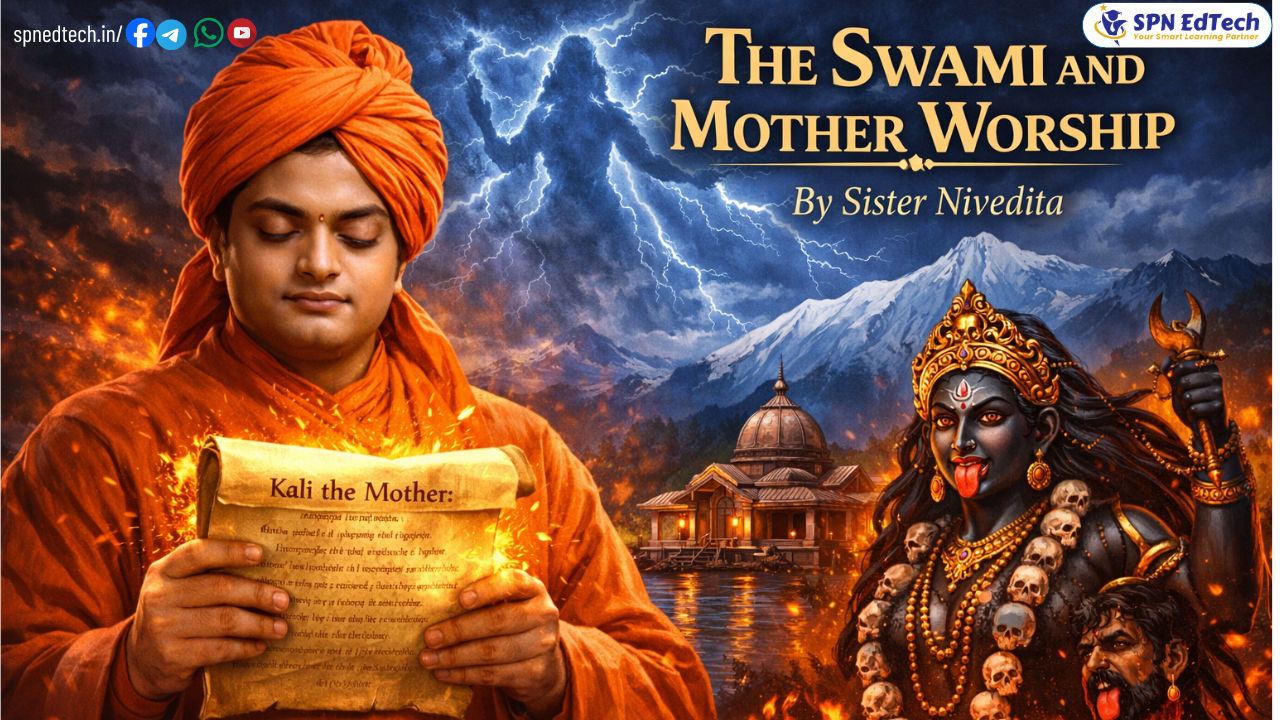
This chapter is a unique testament to the spiritual evolution of Swami Vivekananda and his profound devotion to Mother Kali. Sister Nivedita skillfully portrays the landscape of the Swami's mind here.
- 📖 Chapter Name: The Swami and Mother Worship
- 📚 Main Book: The Master as I Saw Him (1910)
- ✍️ Author: Sister Nivedita (Margaret Elizabeth Noble)
- 🏫 Class : 11 (Semester - 1)
- 📌 Genre: Memoir / Biography
🟢 2. Author Introduction
Margaret Elizabeth Noble, known in history as Sister Nivedita, was the primary disciple of Swami Vivekananda. Born in Ireland in 1867, she moved to India at the Swami's call to dedicate herself to women's education and social service.
- Famous Works: The Web of Indian Life, Kali the Mother, Cradle Tales of Hinduism.
- Writing Style: Her writing reflects deep spirituality, poetic language, and unadulterated reverence for her Guru, Vivekananda. She interpreted Indian culture to the Western world with immense clarity.
🟢 3. Full Summary
In this chapter, Nivedita describes how Swami Vivekananda—who was once a rationalist and a worshiper of the formless Brahman—eventually surrendered at the feet of Mother Kali, the Great Power (Mahashakti).
Key Narrative Points:
- The Worship of Power: Vivekananda believed that life is not just joy, but a combination of pain and sorrow. Thus, he learned to love death as well. To him, Mother Kali was the "Form of Terror" and the "Synthesis of Creation and Destruction."
- Kashmir Travels: This devotion reached its peak during his visits to Amarnath and Kshir Bhavani in 1898. He realized that Mother Kali does everything, and he himself was merely an instrument.
- Kali the Mother: Nivedita mentions the context behind the composition of the famous poem 'Kali the Mother'. The Swami wrote it in a state of deep meditative trance, capturing the cataclysmic form of the Mother.
- Evolution: Vivekananda initially did not believe in idol worship or 'Sakar' (with form) worship. However, through the influence of Sri Ramakrishna and his own life experiences, he understood that Brahman and Shakti (The Mother) are identical.
🟢 4. Theme / Central Idea
1. Advaitism and Mahashakti: This chapter stands on the philosophy that Brahman and Shakti are not different, but one—like fire and its heat.
2. Embracing Death: Swami taught that worshipping only the beautiful is cowardice. A true hero is one who can accept death and destruction as a form of the Mother.
3. Influence of the Guru: It clearly shows how Sri Ramakrishna's 'Mother-centric' emotion transformed a rationalist youth into a total devotee.
🟢 5. Important Explanation
"Terror is Thy name, Death is in Thy breath."
Explanation: Swami believed God is not just kind, but also the Destroyer. The play of that Great Power exists even within natural disasters, pandemics, and death. Through these lines, he describes the fierce (Rudra) form of Mother Kali.
Useful Points for Exams:
- Why did the Swami consider himself a "Child of the Mother"?
- What was the Swami's realization at Kshir Bhavani? (The Mother protects the temple, not humans).
- The necessity of worshipping "The Terrible."
🟢 6. Character Sketch
1. Swami Vivekananda: He is portrayed as a spiritual revolutionary. He is not a conventional devotee but a truth-seeker who reached the ocean of devotion through the path of logic.
2. Sister Nivedita: She is the observer. Having seen her Guru closely, she eloquently expresses his inner conflicts and ultimate peace.
3. Mother Kali (The Divinity): She is presented here not just as an idol, but as a Cosmic Power.
🟢 7. Symbolism
-
✨ Metaphor:
In the poem, "Darkness" is described as the primordial state of creation. It is not merely the absence of light, but the "Mother" herself, in whom all creation eventually dissolves. Furthermore, "The Stars are blotted out" serves as a powerful metaphor for cosmic dissolution (Pralaya). -
✨ Simile:
Vivekananda and Nivedita compare Brahman (the Absolute) and Shakti (the Power) to fire and its heat. Just as heat cannot be separated from fire, Kali (Shakti) is inseparable from Shiva (Brahman). This comparison helps the reader understand the non-dual nature of God. -
✨ Imagery:
The use of "Visual and Auditory Imagery" throughout the chapter is striking:- "The roaring gale" — Auditory imagery that evokes the sound of cosmic upheaval.
- "Dancing on the dead" — A fierce yet spiritually potent visual image representing the destruction of the ego and the illusion of 'Maya'.
-
✨ Symbolism:
- The Sword: Symbolizes 'Viveka' (Discrimination) or knowledge that cuts through the bonds of ignorance.
- The Terrible: A symbol for the harsh realities of life—pain, sorrow, and death—which a true devotee accepts as a gift from the Divine.
- Dance of Doom: Represents the cyclic nature of time and the constant change in the universe.
🟢 8. MCQ Section
(a) Swami Vivekananda (b) Sri Ramakrishna (c) Sister Nivedita (d) Sarada Devi
Ans: (c) Sister Nivedita
(a) America (b) Kashmir (c) London (d) Chennai
Ans: (b) Kashmir
(a) Kali the Mother (b) The Cloud (c) My Play is Done (d) Song of the Free
Ans: (a) Kali the Mother
(a) Only Kind (b) Only Peaceful (c) The Terrible or Rudra (d) None of these
Ans: (c) The Terrible or Rudra
(a) Shiva's (b) Sri Ramakrishna's (c) The Divine Mother's (d) His father's
Ans: (c) The Divine Mother's
(a) Margaret Elizabeth Noble (b) Sara Bull (c) Josephine MacLeod (d) Annie Besant
Ans: (a) Margaret Elizabeth Noble
(a) The Government (b) The Mother (c) Society (d) His own intellect
Ans: (b) The Mother
(a) 1893 (b) 1898 (c) 1902 (d) 1890
Ans: (b) 1898
(a) A Curse (b) A form of Mother Kali (c) A cause of fear (d) Another name for darkness
Ans: (b) A form of Mother Kali
(a) The Wise (b) Bhavatarini (The Mother) (c) Monks (d) Kings
Ans: (b) Bhavatarini (The Mother)
(a) During sleep (b) In a moment of deep meditation and feeling (c) While traveling (d) Before a lecture
Ans: (b) In a moment of deep meditation and feeling
(a) Honor (b) Truth and the Mother (c) Money (d) Power
Ans: (b) Truth and the Mother
(a) Dakshineswar (b) Kshir Bhavani (c) Somnath (d) Kamakhya
Ans: (b) Kshir Bhavani
(a) Rabindranath (b) Vivekananda (c) Nazrul (d) Aurobindo
Ans: (b) Vivekananda
(a) Fearlessness (b) Superstition (c) Only Mantras (d) Sacrifice
Ans: (a) Fearlessness
(a) Friend (b) The Master (c) Brother (d) Prophet
Ans: (b) The Master
(a) Humans (b) Mother Kali (c) Science (d) Politics
Ans: (b) Mother Kali
(a) Fatigue (b) Spiritual transformation (c) Illness (d) Just travel experience
Ans: (b) Spiritual transformation
(a) Balance of destruction and creation (b) Only destruction (c) Only peace (d) Wealth
Ans: (a) Balance of destruction and creation
(a) Bengali (b) English (c) Hindi (d) Sanskrit
Ans: (b) English
🟢 9. One-Line Revision
- 🔹 Author: Sister Nivedita, the primary disciple of Vivekananda.
- 🔹 Core Subject: The history of the Swami's transition from rationalism to Mother worship.
- 🔹 Philosophy: To feel the presence of God/Mother in both the beautiful and the terrible.
- 🔹 Poem: 'Kali the Mother' captures the central emotion of this chapter.
- 🔹 Realization: The Mother does everything; humans are merely instruments in her hands.
- 🔹 Exam Tip: Study the Swami's spiritual evolution and the significance of Kali's fierce form.
Study Notes PDF
Download this article for offline study







Social Platforms