
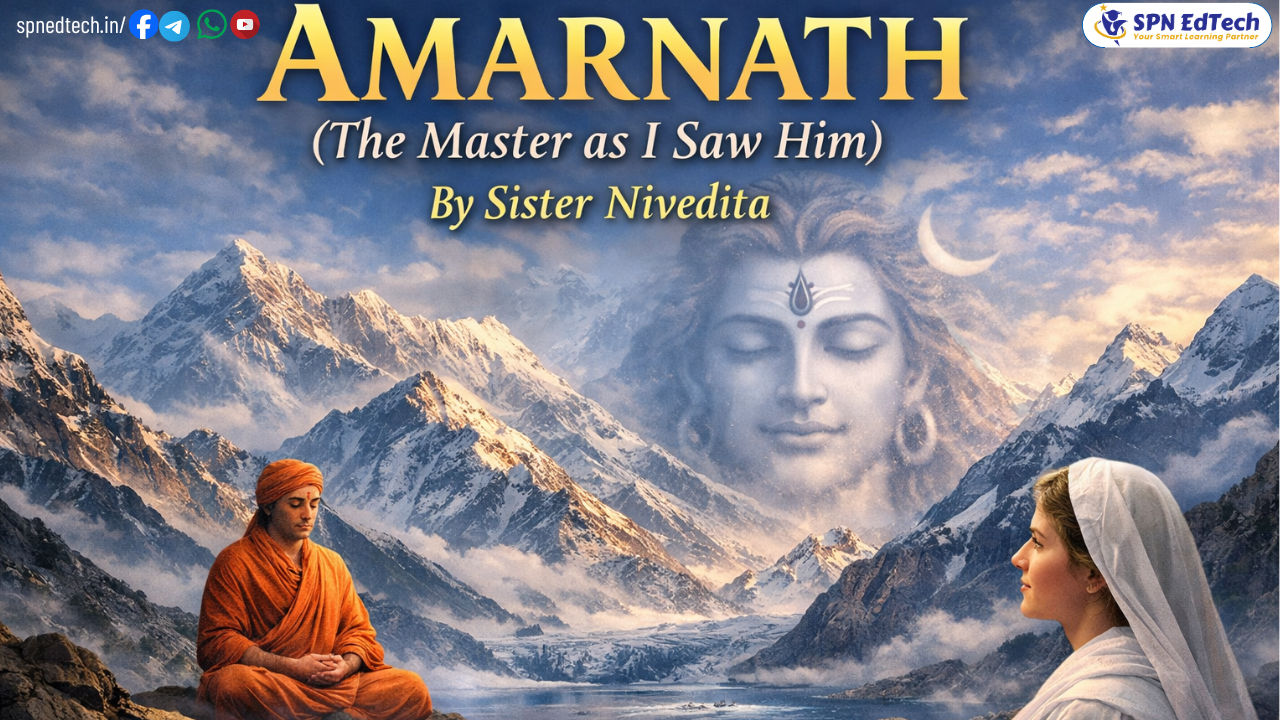
Swami Vivekananda and Sister Nivedita during their historic travels in India.
🟢 1. Basic Info Section
Introduction: This chapter is a profound account of the spiritual peak attained by Swami Vivekananda during his pilgrimage to the holy cave of Amarnath in 1898, as witnessed and recorded by his disciple, Sister Nivedita.
- 📖 Chapter Name: Amarnath (from The Master as I Saw Him)
- ✍️ Author: Sister Nivedita (Margaret Elizabeth Noble)
- 🏫 Class: 12 (Semester-3)
- 📌 Genre: Memoir / Hagiography / Spiritual Biography
🟢 2. Author Introduction
Sister Nivedita, born Margaret Elizabeth Noble in Ireland, was one of the most dedicated disciples of Swami Vivekananda. After meeting Swami Vivekananda in London in 1895, she traveled to India in 1898 and dedicated her life to the service of the Indian people, especially in the fields of education and women's empowerment.
Famous Works: The Web of Indian Life, Cradle Tales of Hinduism, and Footfalls of Indian History.
Writing Style: Her writing is characterized by deep emotional intensity, poetic prose, and a rare ability to bridge Eastern spirituality with Western intellectualism. She portrays the Swami not just as a teacher, but as a living manifestation of the Eternal Truth.
🟢 3. Full Summary (The Journey to the Divine)
In the summer of 1898, Swami Vivekananda decided to undertake the arduous pilgrimage to the Amarnath Cave in the Himalayas. Accompanied by a group including Sister Nivedita, the journey began from Srinagar and passed through Pahalgam. Throughout the trek, Swami Vivekananda adopted the lifestyle of a humble Parivrajaka (wandering monk), strictly following traditional customs, eating simple vegetarian food, and sleeping on the ground.
As they climbed higher into the frozen heights of the Himalayas, Nivedita observed a profound transformation in the Swami. He became increasingly silent, his mind constantly dwelling on Lord Shiva. He ignored physical discomfort, including the biting cold and the steep, rocky terrain, appearing to be in a state of constant prayer.
On August 2nd, 1898, the day of Shravani Purnima, they reached the holy cave. Swami Vivekananda, overwhelmed with devotion, entered the cave wearing nothing but a loincloth, his body covered in holy ash. Inside, he faced the naturally formed Ice Lingam. In that moment, he experienced a deep state of Samadhi (meditative absorption). Nivedita notes that the Swami felt he had been granted the boon of "Death at Will" (Amarnath) by Shiva Himself, meaning he would only leave his body when he chose to do so.
The journey back saw a different Vivekananda—one who was physically exhausted but spiritually radiant. He had touched the very source of his faith, and the experience left an indelible mark on his remaining years.
🟢 4. Theme / Central Idea
The central theme of this account is Spiritual Realization and Total Surrender. It explores the idea that to reach the pinnacle of spirituality, one must shed all worldly identities. Vivekananda, despite being a world-renowned philosopher, approached the cave as a simple, barefoot devotee.
The story also emphasizes the Sanctity of the Indian Landscape, portraying the Himalayas not just as mountains, but as the physical body of the Divine. Another key message is the relationship between Guru and Disciple, where Nivedita struggles to understand the Swami’s mystical heights while remaining steadfast in her devotion.
🟢 5. Important Explanations for Exams
- The Boon of Iccha-Mrityu: This refers to the power to choose the moment of one's death. Vivekananda felt that Lord Shiva had granted him this after his vision in the cave. This is crucial because it foreshadows his passing in 1902.
- The Physical Austerity: Nivedita highlights how the Swami bathed in the freezing waters of the Amarganga before entering the cave. This signifies the purification of the body before meeting the Soul.
- The Silence of the Master: During the journey, the Swami often withdrew into silence. Nivedita explains this as his mind being "absorbed in the Great God" (Mahadeva), showing the transition from a teacher to a seer.
🟢 6. Character Sketch
Swami Vivekananda: In this text, he is portrayed as the Eternal Pilgrim. He is a blend of extreme physical strength and supreme spiritual vulnerability. He is the "Master" who becomes the "Child" of the Great Mother/Father (Shiva). His role is that of a bridge between the human and the divine.
Sister Nivedita: She acts as the Enlightened Observer. Her role is to document the "human side" of the divine struggle. She is honest about her own confusion and her inability to always keep up with the Swami’s spiritual shifts, making her a relatable figure for the reader.
🟢 7. Symbolism & Imagery
- The Ice Lingam: Symbolizes the formless God taking a form that is both pure (white) and temporary (melting), yet eternally recurring.
- The Cave: Represents the Hridaya-Guha (the cave of the heart) where God resides.
- The Ash (Vibhuti): Symbolizes the ultimate reality of life—that everything worldly eventually turns to dust, leaving only the spirit.
🟢 8. MCQ Section (Top 20 Questions)
- 1. In which year did the pilgrimage to Amarnath take place?
(a) 1893 (b) 1898 (c) 1902 (d) 1895
Ans: (b) 1898 - 2. Who accompanied Swami Vivekananda on this pilgrimage?
(a) Sarada Devi (b) Sister Nivedita (c) Max Muller (d) Romain Rolland
Ans: (b) Sister Nivedita - 3. On which auspicious day did they reach the Amarnath Cave?
(a) Diwali (b) Holi (c) Shravani Purnima (d) Shivratri
Ans: (c) Shravani Purnima - 4. What boon did Swami Vivekananda believe he received in the cave?
(a) Wealth (b) Eternal life (c) Death at Will (d) Fame
Ans: (c) Death at Will - 5. Which deity was the Swami's mind constantly focused on during the trip?
(a) Vishnu (b) Shiva (c) Ganesha (d) Indra
Ans: (b) Shiva - 6. What was the name of the river where Swami Vivekananda bathed before entering the cave?
(a) Ganges (b) Yamuna (c) Amarganga (d) Jhelum
Ans: (c) Amarganga - 7. Sister Nivedita’s original name was:
(a) Annie Besant (b) Margaret Noble (c) Mary Lyon (d) Mother Teresa
Ans: (b) Margaret Noble - 8. The "Ice Lingam" in the cave is a symbol of which deity?
(a) Lord Rama (b) Lord Krishna (c) Lord Shiva (d) Lord Brahma
Ans: (c) Lord Shiva - 9. From which city did the journey to Amarnath begin?
(a) Delhi (b) Srinagar (c) Haridwar (d) Varanasi
Ans: (b) Srinagar - 10. How did Swami Vivekananda dress while entering the cave?
(a) In silk robes (b) In a simple loincloth and ash (c) In heavy winter clothes (d) In a Western suit
Ans: (b) In a simple loincloth and ash - 11. What was the Swami's physical state after the vision in the cave?
(a) Energetic and talkative (b) Physically exhausted but spiritually radiant (c) Angry and frustrated (d) Sick and bedridden
Ans: (b) Physically exhausted but spiritually radiant - 12. According to Nivedita, the Swami was a "Master" of:
(a) Politics (b) The Soul (c) Business (d) Mathematics
Ans: (b) The Soul - 13. What did the Swami call the mountain peaks?
(a) Just rocks (b) The seat of the Gods (c) Barriers (d) Tourist spots
Ans: (b) The seat of the Gods - 14. "The Master as I Saw Him" is primarily a:
(a) Fiction novel (b) Personal memoir (c) Political manifesto (d) Scientific journal
Ans: (b) Personal memoir - 15. Which of these animals did they encounter on the trek?
(a) Tigers (b) Ponies and mountain goats (c) Elephants (d) Lions
Ans: (b) Ponies and mountain goats - 16. The Swami’s silence during the journey indicated:
(a) Boredom (b) Deep meditation (c) Illness (d) Anger at his disciples
Ans: (b) Deep meditation - 17. What did the Swami eat during the pilgrimage?
(a) Expensive meat dishes (b) Simple vegetarian food (c) Nothing at all (d) Only fruits
Ans: (b) Simple vegetarian food - 18. What was the primary color associated with the Ice Lingam?
(a) Blue (b) White (c) Red (d) Black
Ans: (b) White - 19. The journey to Amarnath is described by Nivedita as a journey of:
(a) Conquest (b) Exploration (c) Pilgrimage (d) Escape
Ans: (c) Pilgrimage - 20. Who is the "Master" referred to in the book title?
(a) Ramakrishna Paramhansa (b) Swami Vivekananda (c) Swami Abhedananda (d) Rabindranath Tagore
Ans: (b) Swami Vivekananda
🟢 9. One-Line Revision (Exam Last Minute)
- Journey Date: Summer of 1898; reached cave on August 2nd (Shravani Purnima).
- The Core Experience: Swami Vivekananda experienced a profound spiritual union with Lord Shiva.
- The Boon: The realization of "Amarnath" or the boon of dying only when he willed it.
- Nivedita's Observation: She captures the Swami's transition from a teacher to a silent ascetic.
- Setting: The rugged, icy heights of the Kashmir Himalayas, symbolizing spiritual elevation.
- Significance: This chapter highlights the deep roots of Indian monastic tradition and the power of faith.
Study Notes PDF
Download this article for offline study







Social Platforms