
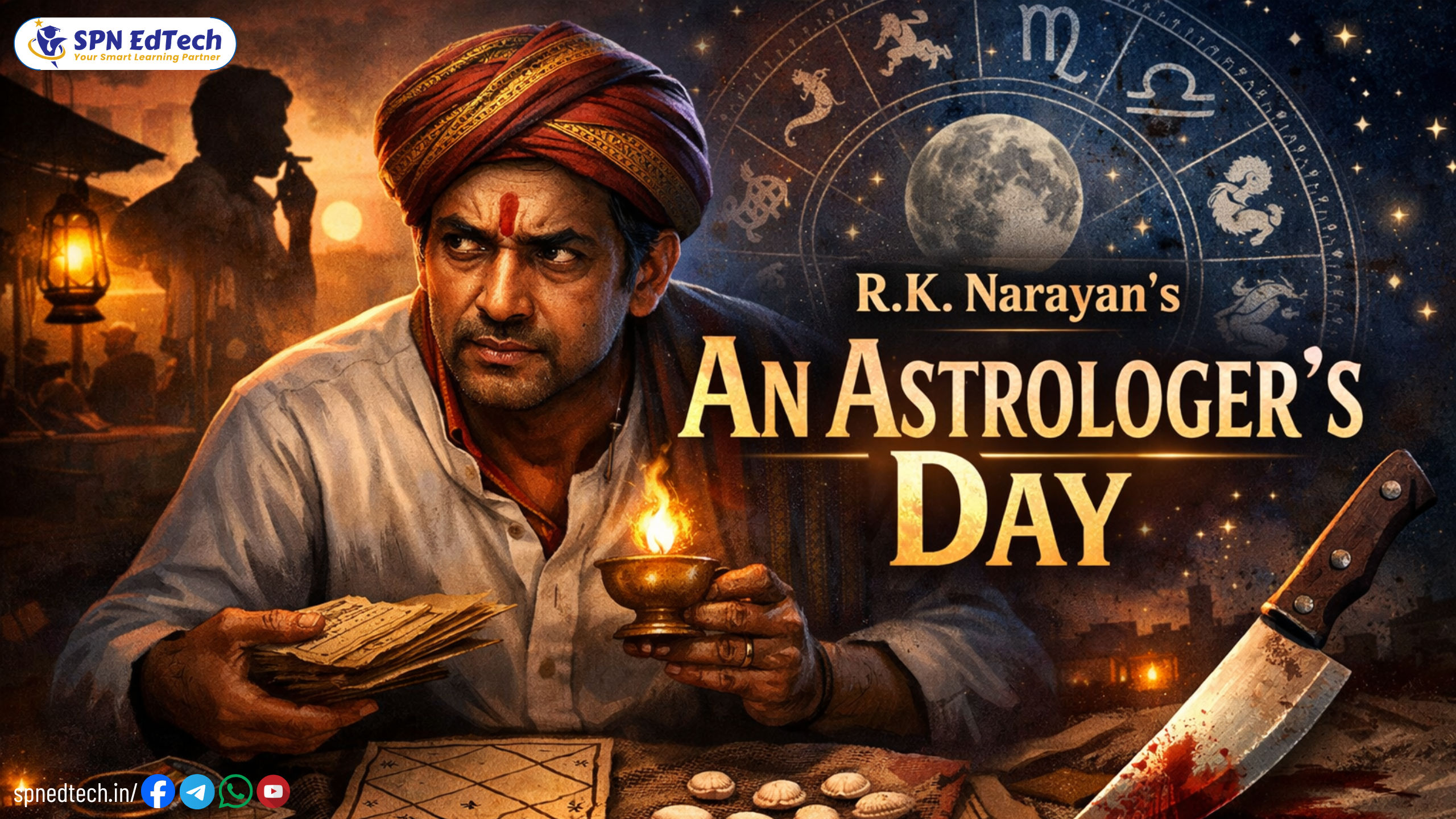
An Astrologer's Day
R.K. Narayan | Complete Analysis, Summary & MCQ 📚
📗 Class 11 · Sem 1 | ✍️ R.K. Narayan | 📖 WBCHSE Syllabus | 🎯 Exam Ready
1. Basic Information
| Story Title | An Astrologer's Day |
| Author | R.K. Narayan |
| Class / Semester | Class 11, Semester 1 |
| Genre | Short Story |
| Source Collection | Malgudi Days |
💡 Remember: The story is originally written in English and is set in the fictional town of Malgudi. Its heart lies in the ironic portrayal of deception, guilt, and the strange games of fate.
2. About the Author
R.K. Narayan (1906–2001) is one of India's greatest English-language authors, who built the fictional town of Malgudi as the setting for most of his stories. His writing brings ordinary people's lives, small everyday events, and the complexity of human nature to life in a simple, humorous style.
His most celebrated works include Swami and Friends, The Guide, The English Teacher, and the collection Malgudi Days, in which this story appears. His style is realistic, satirical, and rooted in sharp observation of daily life — holding a mirror up to the world around us.
🏙️ Creator of Malgudi | 📚 Malgudi Days | 🇮🇳 Indian English Literature | ✨ Realist Writer
3. Complete Summary ⭐
The story opens on a busy roadside in the town of Malgudi, where an astrologer sets up his stall every evening. His forehead is smeared with ash and vermillion, his eyes sharp — all calculated to attract customers. He is no real astrologer; he earns money by listening to people, guessing their problems, and offering reassuring words.
The astrologer gathers his courage and says, "You were stabbed with a knife and thrown into a well — your name is Guru Nayak." Nayak is stunned. The astrologer then tells him, "Your enemy was crushed under a truck four months ago — go back to your village, and never travel south again." Nayak believes him, pays up, and leaves satisfied.
4. Themes & Central Ideas
The central themes of the story are deception, guilt, and the ironic play of fate.
🎭 Irony: A fraudulent astrologer finds freedom from his deepest guilt through his own deception — a masterclass in situational irony.
⚖️ Justice: Justice operates beyond the law — fate delivers its own verdict in unexpected ways.
🌑 The Shadow of the Past: Sin never truly lets go — but knowing the truth can finally set you free.
🎪 Social Critique: A sharp commentary on how superstition and blind faith allow fraudsters to thrive in society.
5. Character Analysis
🔮 The Astrologer (Protagonist)
Nature: Cunning, deceptive, haunted by his past. Skilled at reading people.
Role: The center of the story. His past sin and eventual redemption drive the entire narrative.
😤 Guru Nayak
Nature: Suspicious, vengeful — yet ultimately trusting.
Role: A living symbol of the astrologer's past. His arrival triggers the climax.
👩 The Astrologer's Wife
Nature: Practical, domestic.
Role: The final conversation with her reveals the story's central twist and emotional release.
6. Literary Devices
🎭 Irony
The astrologer claims to know the future but hides his own past. His lies ultimately deliver him from guilt — a perfect example of situational irony at the core of the story.
🕯️ Symbolism
Light and shadow represent truth and deception. The cheroot's flame illuminates Nayak's face — symbolising how hidden truths are eventually revealed from the darkness.
🔮 Foreshadowing
The astrologer's restlessness, fear, and physical unease hint at his guilty past before the revelation is made.
🖼️ Imagery
The vivid depiction of the market — dancing lights, sounds, the press of the crowd — brings the setting to life and deepens the atmosphere of mystery.
7. Important Exam Points
- 📍 The astrologer's appearance: ash and vermillion on his forehead, piercing eyes — all deliberate tools to attract customers
- 📍 Secret of his success: he guesses common problems — marriage, money, relationships — and provides comforting reassurances
- 📍 The market setting: the interplay of light and shadow builds mystery and atmosphere throughout
- 📍 The core twist: the astrologer himself is Nayak's enemy — he conceals his identity and earns his own freedom
- 📍 Most important line: "A great burden has lifted from my heart today" — the emotional and thematic peak of the story
🎯 Exam Focus Areas: Character analysis, summary writing, explaining the Irony in the story, and MCQs.
8. MCQ Section (20 Questions)
- Where does the astrologer set up his stall?
a) At home b) On the roadside c) In a temple d) At a railway station
✓ Answer: b) On the roadside - What is the real reason behind the astrologer's sharp, bright eyes?
a) Astrological knowledge b) A calculated effort to attract customers c) The effect of ash d) The effect of vermillion
✓ Answer: b) A calculated effort to attract customers - What mark does Guru Nayak carry on his body?
a) A knife wound b) A burn mark c) A broken arm d) No marks at all
✓ Answer: a) A knife wound - Why did the astrologer become an astrologer?
a) It was his hobby b) To escape his past c) He had genuine knowledge d) For money alone
✓ Answer: b) To escape his past - What was Guru Nayak searching for?
a) To know his future b) Revenge c) Money d) His wife
✓ Answer: b) Revenge - How does the astrologer claim Nayak's enemy died?
a) By a knife b) Crushed under a truck c) Fell into a well d) By poison
✓ Answer: b) Crushed under a truck - What does the astrologer feel at the end of the story?
a) Sadness b) Relief and freedom c) Anger d) Fear
✓ Answer: b) Relief and freedom - Why is the light from the cheroot significant?
a) It lights up the environment b) It reveals Guru Nayak's face c) It is used for smoking d) It starts a fire
✓ Answer: b) It reveals Guru Nayak's face - Where is the story set?
a) Malgudi b) Delhi c) Kolkata d) Bombay
✓ Answer: a) Malgudi - What is the real secret behind the astrologer's success?
a) Knowledge of stars b) His ability to understand human nature c) Divine blessings d) Reading books
✓ Answer: b) His ability to understand human nature - What is the astrologer's real profession?
a) A genuine astrologer b) A fraud / trickster c) A teacher d) A doctor
✓ Answer: b) A fraud / trickster - Where does the astrologer tell Guru Nayak to go?
a) North b) Back to his village c) To the city d) Abroad
✓ Answer: b) Back to his village - What is the primary literary device used in this story?
a) Simile b) Irony c) Alliteration d) Metaphor
✓ Answer: b) Irony - Which collection does this story come from?
a) Swami and Friends b) Malgudi Days c) The Guide d) The English Teacher
✓ Answer: b) Malgudi Days - Why does Guru Nayak believe the astrologer and leave?
a) Out of fear b) The astrologer knew his name c) He was paid d) He was getting late
✓ Answer: b) The astrologer knew his name - When does the astrologer arrive home?
a) In the morning b) At midnight c) In the evening d) In the afternoon
✓ Answer: b) At midnight - What is the main theme of the story?
a) Love b) Deception and redemption c) War d) Education
✓ Answer: b) Deception and redemption - What does the astrologer have smeared on his forehead?
a) Ash and vermillion b) A tattoo c) Nothing d) Sandalwood paste
✓ Answer: a) Ash and vermillion - What does "a great burden has lifted from my heart" mean?
a) His physical pain is gone b) He is freed from his guilt c) His debt is cleared d) He is no longer tired
✓ Answer: b) He is freed from his guilt - What genre does this story belong to?
a) Poetry b) Drama / Play c) Short Story d) Novel
✓ Answer: c) Short Story
9. Quick Revision (One-Liners)
- 🔮 The astrologer is a fake — in his past, he stabbed Guru Nayak and threw him into a well, then fled.
- 😤 Nayak was seeking revenge — the astrologer tricks him into believing his enemy is dead and sends him away.
- 🎭 Themes: Deception + Guilt + The ironic play of fate.
- 🕯️ The cheroot's light = a symbol of revelation. Irony = the astrologer's own lies save him.
- 💬 Most important line: "A great burden has lifted from my heart today."
- 📍 Exam Focus: Character analysis · Summary writing · Explaining Irony · MCQs.
📌 Download PDF: Coming Soon! | 📢 Share with Friends: Spread the knowledge!
Study Notes PDF
Download this article for offline study







Social Platforms