
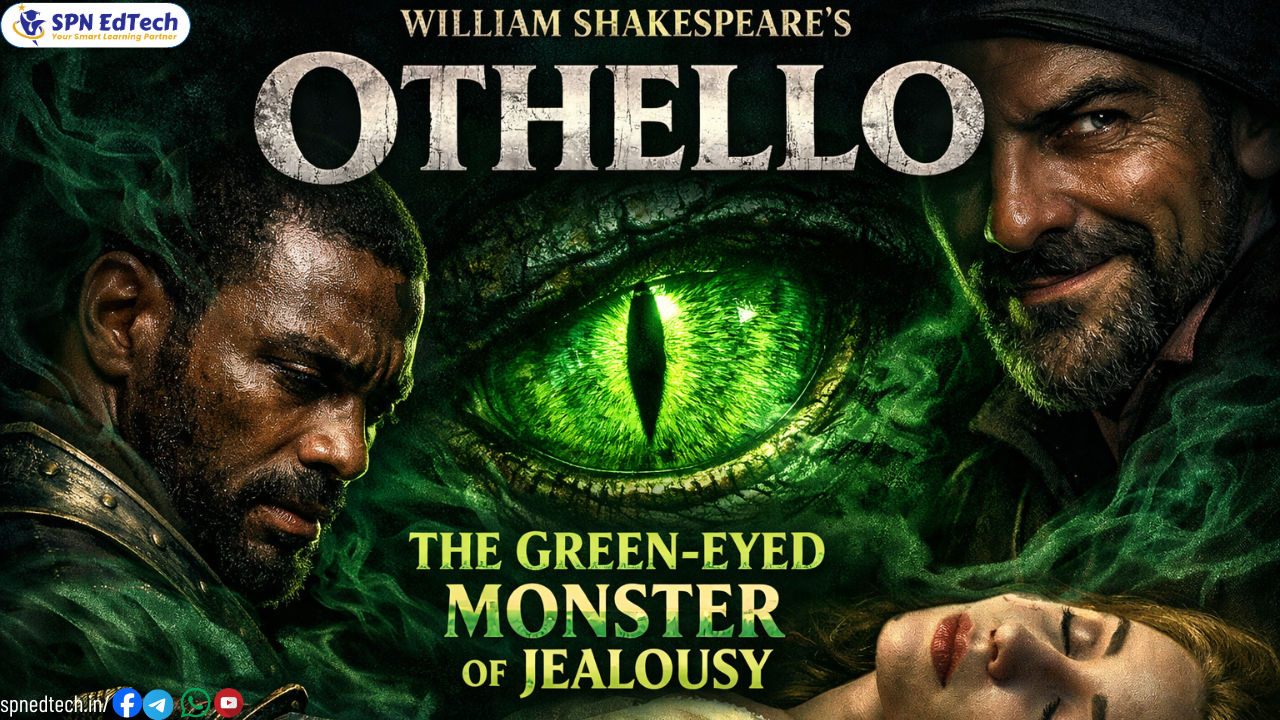
Welcome to our comprehensive guide on William Shakespeare's masterpiece, Othello. This article provides an in-depth analysis of the play, its characters, themes, and everything you need for your academic preparations.
🟢 1. Basic Info Section
Introduction: Othello (The Tragedy of Othello, the Moor of Venice) is one of Shakespeare's "Great Tragedies." It is a gripping tale of love, jealousy, betrayal, and racial tension, set against the backdrop of the wars between Venice and the Ottoman Empire.
- 📖 Chapter Name: Othello
- ✍️ Author: William Shakespeare
- 🏫 Class : 11 (Semester-1)
- 📌 Genre: Tragedy / Drama
🟢 2. Author Introduction
William Shakespeare (1564–1616), often called the "Bard of Avon," is widely regarded as the greatest dramatist in history. Born in Stratford-upon-Avon, he was an English playwright, poet, and actor.
Famous Works: His legendary portfolio includes Hamlet, Macbeth, King Lear, Romeo and Juliet, and 154 sonnets. His plays have been translated into every major living language.
Writing Style: Shakespeare is known for his mastery of blank verse (iambic pentameter), complex character psychological depth, and the ability to weave universal human emotions—like love, ambition, and jealousy—into timeless narratives.
🟢 3. Full Summary (The Tragedy of the Moor)
The play begins in Venice, where Othello, a noble Moorish general, has secretly married Desdemona, the daughter of Senator Brabantio. Despite the racial prejudices of the time, Othello is respected for his military prowess. However, his ensign, Iago, harbors deep resentment because Othello promoted a younger man, Michael Cassio, over him.
Iago begins a psychological war. When the scene shifts to Cyprus during a Turkish invasion, Iago manipulates Cassio into a drunken brawl, leading Othello to strip him of his rank. Iago then cunningly suggests to Othello that Desdemona is having an affair with Cassio. He uses a misplaced handkerchief—Othello’s first gift to Desdemona—as "proof" of her infidelity.
Consumed by "the green-eyed monster" of jealousy, Othello’s mind degrades. In the tragic climax, Othello smothers Desdemona in her bed. Soon after, Iago’s wife, Emilia, reveals the truth about the handkerchief and Iago's villainy. Realizing he has killed his innocent wife, a devastated Othello commits suicide. Iago is arrested, but the damage is irreversible.
🟢 4. Theme / Central Idea
- Jealousy: Referred to as the "green-eyed monster," it is the primary driving force that destroys Othello’s reason.
- Race and Outsider Status: As a "Moor" in Venice, Othello is always an outsider, making him more vulnerable to Iago’s manipulations.
- Appearance vs. Reality: Iago is known as "honest Iago" by everyone, yet he is the most deceptive character in the play.
- Betrayal and Loyalty: The play explores how trust can be easily manipulated and broken.
🟢 5. Important Events & Explanations
1. The Handkerchief: This is the most crucial symbol. It represents Desdemona’s fidelity. When Iago plants it in Cassio’s room, it becomes the "ocular proof" Othello demanded to confirm his jealousy.
2. Iago’s Soliloquies: Through these, the audience learns Iago's "motiveless malignity." He hates Othello for reasons that often seem contradictory, proving his purely evil nature.
3. The Willow Song: Sung by Desdemona before her death, it foreshadows her tragic end and symbolizes her grief and resignation.
🟢 6. Character Sketch (Detailed)
1. Othello
A Christian Moor and general of the Venetian army. He is eloquent and physically powerful but emotionally insecure. His fatal flaw (Hamartia) is his intense jealousy and his tendency to trust the wrong person (Iago) while doubting his loyal wife.
2. Desdemona
The daughter of Brabantio. She is courageous, loving, and remarkably faithful. Even in her dying breath, she tries to protect Othello by claiming she killed herself. She represents purity and innocence caught in a web of evil.
3. Iago
Othello’s ensign and the play’s antagonist. He is one of Shakespeare’s most complex villains. He is a master manipulator who understands human weaknesses and exploits them with surgical precision. He operates without a clear moral compass.
4. Michael Cassio
Othello’s loyal and educated lieutenant. Though honorable, he has a weakness for alcohol and a flirtatious nature, which Iago uses to frame him for an affair with Desdemona.
5. Emilia
Iago’s wife and Desdemona’s attendant. Initially cynical, she becomes the hero of the final act by exposing Iago's lies at the cost of her own life.
🟢 7. Symbolism & Imagery
- The Handkerchief: Symbol of love and chastity. Its loss symbolizes the loss of Desdemona's honor in Othello's eyes.
- Animals: Iago uses animal imagery (black ram, Barbary horse) to dehumanize Othello and emphasize racial differences.
- The Sea and Storms: Symbolize the chaotic emotions and the shift from the order of Venice to the chaos of Cyprus.
- Light and Dark: Represents the racial tension and the conflict between Desdemona's innocence (light) and Iago's evil (dark).
🟢 8. MCQ Section (Exam Special)
(a) Othello (b) Cassio (c) Iago (d) Brabantio
Ans: (c) Iago
(a) Italian (b) Moor (c) Greek (d) Turkish
Ans: (b) Moor
(a) A ring (b) A letter (c) A handkerchief (d) A necklace
Ans: (c) A handkerchief
(a) Venice (b) Rome (c) Cyprus (d) London
Ans: (c) Cyprus
(a) Lodovico (b) Gratiano (c) Brabantio (d) Montano
Ans: (c) Brabantio
(a) Othello insulted him (b) Othello promoted Cassio (c) Othello killed his father (d) He wants to be General
Ans: (b) Othello promoted Cassio
(a) She escapes (b) She is poisoned (c) She is smothered by Othello (d) She kills herself
Ans: (c) She is smothered by Othello
(a) Othello (b) Iago (c) Cassio (d) Roderigo
Ans: (b) Iago
(a) Fear (b) Ambition (c) Jealousy (d) Hatred
Ans: (c) Jealousy
(a) Gambling (b) Anger (c) Alcohol (d) Laziness
Ans: (c) Alcohol
(a) Othello's brother (b) A Venetian gentleman in love with Desdemona (c) A soldier (d) A spy
Ans: (b) A Venetian gentleman in love with Desdemona
(a) Bianca (b) Emilia (c) Desdemona (d) Iago
Ans: (a) Bianca
(a) Iago kills him (b) He is executed (c) He commits suicide (d) Old age
Ans: (c) He commits suicide
(a) Joy (b) Betrayal and Death (c) Marriage (d) War
Ans: (b) Betrayal and Death
(a) Othello (b) Desdemona (c) Cassio (d) Emilia
Ans: (c) Cassio
(a) General (b) Lieutenant (c) Ensign (d) Captain
Ans: (c) Ensign
(a) Othello (b) Cassio (c) Emilia (d) Roderigo
Ans: (c) Emilia
(a) A ring (b) A shawl (c) A handkerchief (d) A dagger
Ans: (c) A handkerchief
(a) Plutarch (b) Cinthio (c) Chaucer (d) Virgil
Ans: (b) Cinthio
(a) Othello (b) Iago (c) Brabantio (d) Cassio
Ans: (b) Iago
🟢 9. One-Line Revision (Last Minute)
- 🔹 Othello is a tragic hero whose downfall is caused by jealousy.
- 🔹 Iago is the manipulator who uses everyone as pawns for his revenge.
- 🔹 The Handkerchief is the physical evidence that seals Desdemona’s fate.
- 🔹 Venice represents law and order, while Cyprus represents the zone of chaos.
- 🔹 Emilia's honesty at the end is the only moral victory in the tragedy.
- 🔹 The play teaches how manipulation can destroy even the strongest bonds of love.
Study Notes PDF
Download this article for offline study







Social Platforms