
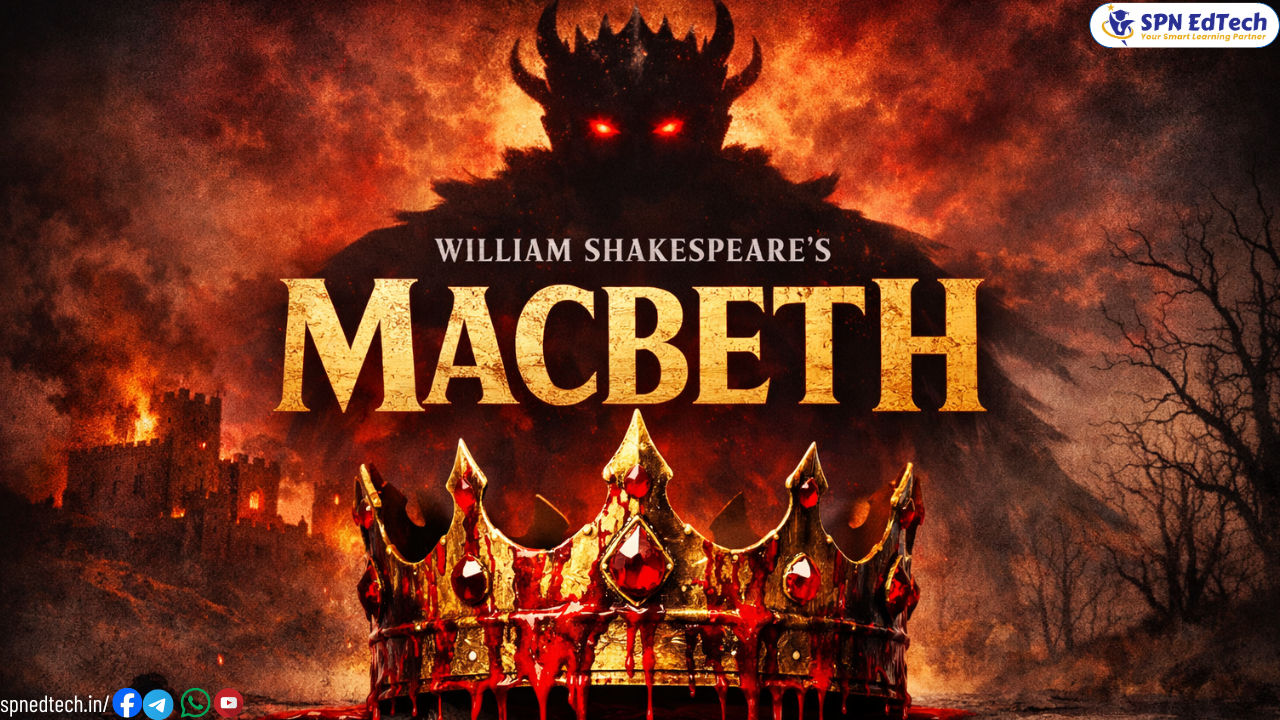
1. Basic Info Section
Introduction: Macbeth is one of William Shakespeare's most potent and dark tragedies. It explores the damaging physical and psychological effects of political ambition on those who seek power for its own sake. Known popularly as "The Scottish Play," it dramatizes the corrosive nature of unchecked greed and guilt.
- 📖 Chapter Name: Macbeth
- ✍️ Author: William Shakespeare
- 🏫 Class : 11 (Semester-1)
- 📌 Genre: Tragedy (Drama)
2. Author Introduction
William Shakespeare (1564–1616) was an English playwright, poet, and actor, widely regarded as the greatest writer in the English language. He is often called England's national poet and the "Bard of Avon."
Famous Works: Hamlet, Othello, King Lear, Romeo and Juliet, and The Tempest.
Writing Style: Shakespeare utilized blank verse (unrhymed iambic pentameter), intricate wordplay, and deep psychological realism. His ability to capture the universal human condition through complex metaphors and dramatic irony remains unparalleled in literary history.
3. Full Summary
The play begins in Scotland, where Macbeth, a brave general, receives a prophecy from three witches that he will one day become King. Spurred by his ambition and goaded by his wife, Lady Macbeth, he murders King Duncan and takes the Scottish throne for himself.
However, his reign is quickly consumed by guilt and paranoia. To maintain his power, Macbeth is forced to commit more murders, including his friend Banquo and the family of Macduff. The bloodbath and consequent civil war swiftly take Macbeth and Lady Macbeth into the realms of madness and death.
Lady Macbeth, unable to bear the guilt of their crimes, eventually commits suicide. Meanwhile, Macduff leads an army supported by the English forces and Malcolm (Duncan's son). In the final battle, Macduff kills Macbeth, restoring the rightful heir to the throne and ending the bloody tyranny.
4. Theme / Central Idea
Unchecked Ambition: The primary theme is the destruction wrought when ambition goes beyond moral constraints. Macbeth is not naturally a villain, but his desire for power leads him to total moral decay.
Fate vs. Free Will: The play questions whether the witches' prophecy is a fixed fate or if Macbeth’s own choices bring about his downfall.
Appearance vs. Reality: "Fair is foul, and foul is fair." Throughout the play, characters and situations are not what they seem, highlighting the theme of deception.
Guilt and Remorse: The psychological toll of crime is depicted through the insomnia and hallucinations suffered by both Macbeth and Lady Macbeth.
5. Important Explanation
The Dagger Speech: Before killing Duncan, Macbeth sees a "dagger of the mind," symbolizing his internal conflict and the beginning of his psychological breakdown.
The "Out, Damned Spot" Scene: This represents Lady Macbeth's transition from a cold-hearted accomplice to a broken woman consumed by a subconscious guilt that cannot be "washed away."
Useful Exam Points:
- The role of the supernatural (Three Witches) in influencing human action.
- The reversal of gender roles between Macbeth and Lady Macbeth in the first half of the play.
- The significance of the Great Chain of Being—how Duncan’s murder disrupts the natural order of the world.
6. Character Sketch
Macbeth
Initially a valiant and loyal thane, Macbeth is a tragic hero. His "vaulting ambition" is his tragic flaw (Hamartia). He is deeply sensitive and has a powerful imagination, which makes his guilt manifest as terrifying hallucinations. By the end of the play, he becomes a cynical tyrant who views life as "a tale told by an idiot."
Lady Macbeth
One of Shakespeare's most complex female characters. She is more ambitious and ruthless than her husband at the start, famously asking spirits to "unsex" her. However, she lacks the stamina for evil; while Macbeth grows harder, she crumbles under the weight of her conscience.
The Three Witches
They represent the "Weird Sisters" or Fate. They do not force Macbeth to act, but their ambiguous prophecies tempt him into making fatal choices. They provide the play with its eerie, supernatural atmosphere.
Banquo
Macbeth’s brave colleague. Unlike Macbeth, Banquo is cautious of the witches' words. He represents the path Macbeth could have taken: staying loyal and trusting in providence rather than murder.
7. Symbolism & Imagery
- Blood: Symbolizes guilt. It "stains" the hands of the protagonists and cannot be cleaned.
- Sleep: Symbolizes innocence. Macbeth "murders sleep," and thereafter, neither he nor his wife can find peace.
- Weather and Nature: Thunder, lightning, and strange occurrences in the animal kingdom symbolize the disorder in the political world.
- Clothing: Macbeth is often described as wearing "borrowed robes," symbolizing that the title of King does not fit his moral character.
8. MCQ Section (Exam Oriented)
(a) Banquo (b) Malcolm (c) Macduff (d) Fleance
Ans: (c) Macduff
(a) He will be king (b) His descendants will be kings (c) He will die young (d) He will betray Macbeth
Ans: (b) His descendants will be kings
(a) Macbeth (b) Duncan (c) Edward (d) Ross
Ans: (b) Duncan
(a) Macbeth (b) Lady Macbeth (c) The Three Witches (d) The Porter
Ans: (c) The Three Witches
(a) At his palace in Forres (b) At Macbeth’s castle in Inverness (c) On the battlefield (d) At Fife
Ans: (b) At Macbeth’s castle in Inverness
(a) A ghost (b) A floating dagger (c) A bloody child (d) A crown
Ans: (b) A floating dagger
(a) Sherwood Forest (b) Birnam Wood (c) Black Forest (d) Arden Forest
Ans: (b) Birnam Wood
(a) He is a ghost (b) He was not born of woman (C-section) (c) He uses a magic sword (d) Macbeth is already dead
Ans: (b) He was not born of woman (C-section)
(a) Malcolm (b) Donalbain (c) Macduff (d) Fleance
Ans: (b) Donalbain
(a) Greed (b) Lust (c) Ambition (d) Jealousy
Ans: (c) Ambition
(a) The Witches (b) The Porter (c) The Murderers (d) Seyton
Ans: (b) The Porter
(a) Duncan’s ghost (b) Banquo’s ghost (c) Lady Macbeth (d) A witch
Ans: (b) Banquo’s ghost
(a) Thane of Cawdor (b) King of Scotland (c) Thane of Glamis (d) Prince of Cumberland
Ans: (c) Thane of Glamis
(a) Lady Macduff (b) Hecate (c) Lady Macbeth (d) The Gentlewoman
Ans: (c) Lady Macbeth
(a) Macbeth himself (b) Hired murderers (c) Macduff (d) Malcolm
Ans: (b) Hired murderers
(a) Athena (b) Hecate (c) Hera (d) Medusa
Ans: (b) Hecate
(a) Insomnia (b) Loss of peace and guilt (c) A curse (d) Physical death
Ans: (b) Loss of peace and guilt
(a) Colmekill (b) Scone (c) Fife (d) London
Ans: (b) Scone
(a) Ireland (b) England (c) France (d) Norway
Ans: (b) England
(a) Optimism (b) Nihilism/Despair (c) Wisdom (d) Madness
Ans: (b) Nihilism/Despair
9. One-Line Revision
- Ambition: The primary driver of the tragedy is Macbeth’s unchecked ambition.
- Supernatural: The Witches act as catalysts, not the direct cause of evil.
- Blood & Water: Symbols of lingering guilt and the attempt at purification.
- Natural Order: Duncan's murder triggers chaos in the natural world.
- Tragic Hero: Macbeth falls from a position of honor to a state of total moral ruin.
- Justice: The play ends with the restoration of the rightful King, Malcolm.
Study Notes PDF
Download this article for offline study







Social Platforms