
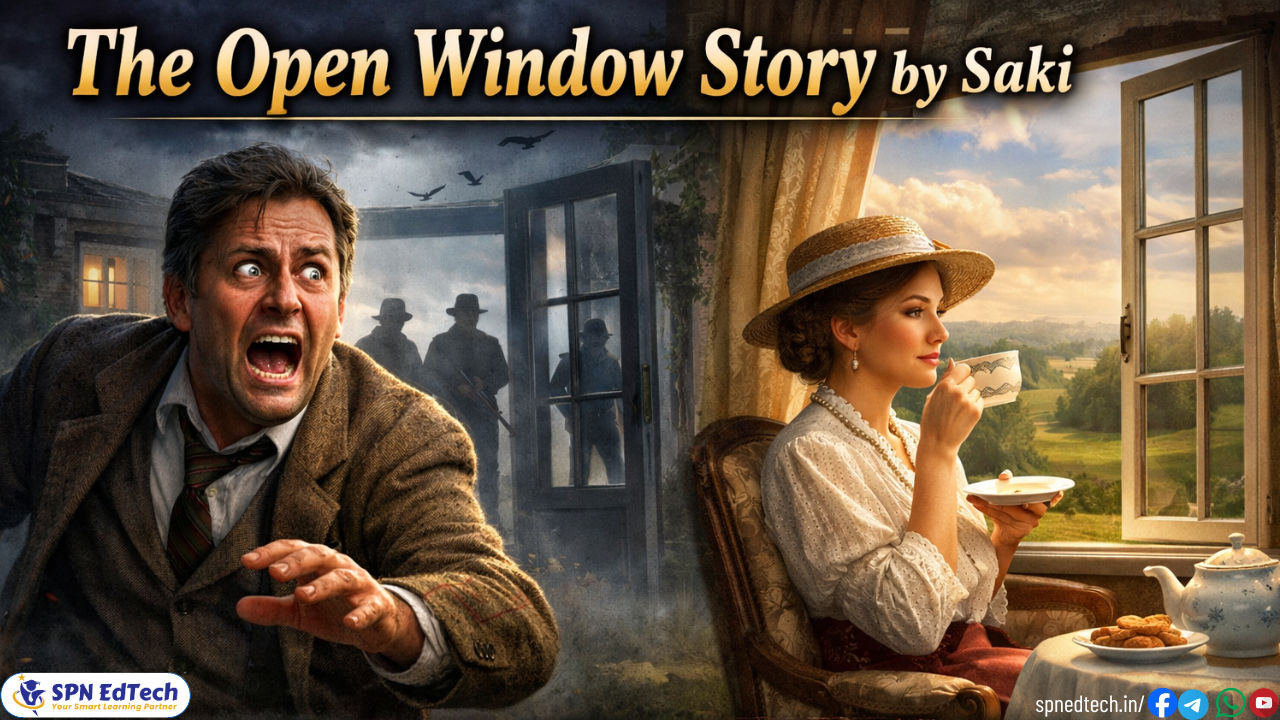
1. Basic Info Section
Introduction: "The Open Window" is one of Saki's most celebrated short stories, known for its wit, irony, and unexpected twist ending. It explores the themes of deception and the power of imagination.
- 📖 Chapter Name: The Open Window
- ✍️ Author: Saki (H.H. Munro)
- 🏫 Class : 11 (Semester-1)
- 📌 Genre: Short Story / Satire / Psychological Fiction
2. Author Introduction
Hector Hugh Munro (1870–1916), better known by his pen name Saki, was a British writer whose stories offer a satirical and often mischievous view of Edwardian society and culture. He is considered a master of the short story format.
Famous Works: His notable works include The Chronicles of Clovis and Beasts and Super-Beasts. His style is characterized by sharp wit, elegant vocabulary, and macabre humor. He often used animal motifs and clever children to mock the pretentiousness of the adult world.
3. Full Summary (The Story)
The story follows Framton Nuttel, a man suffering from "nerve issues" who retreats to the countryside for a rest cure. He visits the home of Mrs. Sappleton with a letter of introduction. While waiting for Mrs. Sappleton, he is entertained by her fifteen-year-old niece, Vera.
Vera, noticing Framton's nervous state and his lack of knowledge about the locals, weaves a tragic tale. She points to a large French window that is kept open, claiming that three years ago to the day, Mrs. Sappleton’s husband and her two brothers went out through that window to hunt and never returned, presumably swallowed by a bog. Vera claims her aunt keeps the window open, believing they will one day walk back in.
When Mrs. Sappleton arrives, she talks cheerfully about her husband's imminent return from hunting, which Framton finds horrifying, believing she is delusional. Suddenly, three figures appear walking across the lawn toward the window. Terrified, thinking he is seeing ghosts, Framton bolts from the house without a word. The story ends with the revelation that the men were never dead; Vera had simply made up the story. Saki concludes with the iconic line: "Romance at short notice was her speciality."
4. Theme / Central Idea
- Deception and Storytelling: The power of a well-told lie to manipulate reality.
- Appearance vs. Reality: How Framton’s fragile mental state makes him a victim of a child's imagination.
- Sanity vs. Insanity: The contrast between Framton’s actual illness and the "tragedy" Vera creates.
- The Social Mask: Saki mocks the rigid politeness of the British upper class.
5. Important Explanation
The Window as a Symbol: The window represents a bridge between reality (the hunting party) and fiction (Vera’s ghost story). To Mrs. Sappleton, it's a way home; to Framton, it’s a portal for the dead.
Irony: Framton came to the country for a "nerve cure," but the experience he has at the Sappleton home is likely to make his nervous condition much worse.
Vera's Name: Paradoxically, her name means "truth" (from the Latin 'Veritas'), yet she is the most dishonest character in the story.
6. Character Sketch
1. Vera (The Niece): A "self-possessed" fifteen-year-old girl. She is the protagonist/antagonist who drives the plot. She is highly intelligent, mischievous, and a natural performer. She quickly identifies Framton’s weaknesses and exploits them for her own entertainment.
2. Framton Nuttel: A nervous, fragile man who is obsessed with his own illnesses. He represents the gullible and self-centered nature of certain city-dwellers. He lacks social intuition, making him the perfect target for Vera’s prank.
3. Mrs. Sappleton: The aunt of Vera. She is cheerful and polite, representing the mundane reality of the story. She is completely unaware of the "tragedy" her niece has invented, which adds to the comedic irony when she speaks about her husband.
7. Symbolism & Literary Devices
1. The Open Window (Central Symbol): The window symbolizes the boundary between fact and fiction. To Mrs. Sappleton, it represents hope and the physical reality of her husband's return. To Vera, it is a canvas for her imaginative "romance" or lies. To Framton, it becomes a portal of horror.
2. Irony (Situational & Verbal):
- Situational Irony: Framton visits the country to heal his nerves but leaves in a state of total nervous collapse.
- Verbal Irony: Vera’s name is derived from "Veritas" (Truth), yet she never tells the truth.
3. Imagery: Saki uses vivid imagery to heighten the suspense, such as the "treacherous piece of bog" and the description of the three figures walking through the "deepening twilight" with their muddy coats and the brown spaniel. This helps the reader (and Framton) visualize the "ghosts" clearly.
4. Foreshadowing: Vera’s initial questioning—asking Framton how much he knows about her aunt—is subtle foreshadowing. She is "testing the waters" to see how much of a lie she can get away with based on his ignorance of the local people.
5. Metaphor: The "Nerve Cure" is a metaphor for the fragile state of the urban upper class, who are easily unsettled by the raw, unpredictable nature of the countryside and the "wild" imagination of the youth.
"Romance at short notice was her speciality." — This final line uses the word 'romance' as a metaphor for extravagant, fictional storytelling.
8. MCQ Section (20 Questions)
(a) Framton Nuttel (b) Saki (c) Mr. Sappleton (d) Ronnie
Ans: (a) Framton Nuttel
(a) 12 (b) 15 (c) 18 (d) 20
Ans: (b) 15
(a) For a job (b) To visit family (c) For a nerve cure (d) To hunt birds
Ans: (c) For a nerve cure
(a) A fire (b) A great tragedy (c) A wedding (d) A burglary
Ans: (b) A great tragedy
(a) Shot in a war (b) Engulfed in a bog (c) Car accident (d) Drowned in a pool
Ans: (b) Engulfed in a bog
(a) For fresh air (b) Because the latch was broken (c) Expecting the dead to return (d) To let the dog in
Ans: (c) Expecting the dead to return
(a) Black (b) White (c) Brown (d) Not mentioned
Ans: (c) Brown
(a) His doctor (b) His mother (c) His sister (d) His boss
Ans: (c) His sister
(a) A white waterproof coat (b) A fishing rod (c) A bag of groceries (d) A lantern
Ans: (a) A white waterproof coat
(a) Framton (b) Ronnie (c) Bertie (d) Jack
Ans: (b) Ronnie
(a) "Home Sweet Home" (b) "Bertie, why do you bound?" (c) "London Bridge" (d) "The Hunter's Song"
Ans: (b) "Bertie, why do you bound?"
(a) He says goodbye politely (b) He walks slowly (c) He bolts out wildly (d) He waits for a carriage
Ans: (c) He bolts out wildly
(a) He was late for a train (b) He had a fear of dogs (c) He saw a ghost (d) He was feeling sick
Ans: (b) He had a fear of dogs
(a) London (b) Paris (c) The banks of the Ganges (d) New York
Ans: (c) The banks of the Ganges
(a) Selfish (b) Calm and confident (c) Angry (d) Shy
Ans: (b) Calm and confident
(a) H.H. Munro (b) O. Henry (c) Mark Twain (d) Guy de Maupassant
Ans: (a) H.H. Munro
(a) Framton meeting Vera (b) The return of the hunting party (c) Framton talking about his health (d) Vera's second lie
Ans: (b) The return of the hunting party
(a) Tragic (b) Humorous and Ironic (c) Romantic (d) Horrific
Ans: (b) Humorous and Ironic
(a) Love (b) Imaginative fiction/lying (c) Poetry (d) Adventure
Ans: (b) Imaginative fiction/lying
(a) That he would meet ghosts (b) That he would mope alone and not talk to anyone (c) That he would get lost (d) That he would lose his letters
Ans: (b) That he would mope alone and not talk to anyone
9. One-Line Revision
- 🔹 Framton Nuttel visits the country for a nerve cure.
- 🔹 Vera, the niece, tells a fake story about a hunting tragedy.
- 🔹 The "Open Window" is supposedly kept for ghosts to return.
- 🔹 The hunting party returns alive, scaring Framton away.
- 🔹 Vera invents another lie about Framton’s fear of dogs.
- 🔹 Theme: The irony of a man seeking peace but finding chaos through fiction.
Study Notes PDF
Download this article for offline study







Social Platforms