
1. Basic Information
Introduction: "The Story of an Hour" is a landmark short story in American literature, known for its powerful exploration of female independence and the psychological complexity of marriage in the 19th century.
- 📖 Chapter Name: The Story of an Hour
- ✍️ Author: Kate Chopin
- 🏫 Class : 11 (Semester-1)
- 📌 Genre: Short Story / Feminist Literature
2. Author Introduction
Kate Chopin (1850–1904) was a prominent American author of short stories and novels based in Louisiana. She is now considered a forerunner of 20th-century feminist authors.
Famous Works: Her most notable works include the novel The Awakening and short stories like Desiree’s Baby and The Storm.
Writing Style: Chopin’s style is characterized by Literary Realism, focusing on the inner lives of women, their desires, and the social constraints of her time. She uses irony and symbolism to critique the institution of marriage.
3. Full Summary
The story begins with the news of Brently Mallard's death in a railroad disaster. His wife, Louise Mallard, who suffers from a "heart trouble," is informed gently by her sister Josephine and her husband's friend Richards.
Initially, Louise reacts with immediate grief, weeping wildly in her sister's arms. However, when she goes to her room alone and sits looking out the window, a strange change occurs. She begins to realize that her husband's death means she is now "free, free, free!"
She reflects on her marriage; while Brently was kind and she sometimes loved him, the prospect of living for herself for the coming years fills her with joy. She imagines a long life of independence. Eventually, she emerges from her room and walks downstairs. Suddenly, the front door opens, and Brently Mallard enters, alive and unaware of the accident. Seeing him, Louise suffers a sudden heart attack and dies. The doctors ironically claim she died of "the joy that kills."
4. Theme / Central Idea
- The Forbidden Joy of Independence: The story explores the idea that for a woman in the 19th century, true freedom could only be found outside of marriage.
- The Oppressiveness of Marriage: Even a "kind" marriage could be a prison where one person's will is imposed on another.
- Irony of Fate: The contrast between Louise’s internal liberation and the external tragedy creates a sharp situational irony.
5. Important Explanation & Exam Points
"The Joy That Kills": This is the most crucial phrase. The doctors believe she died of joy seeing her husband alive. However, the reader knows she died of the shock and despair of losing her newfound freedom.
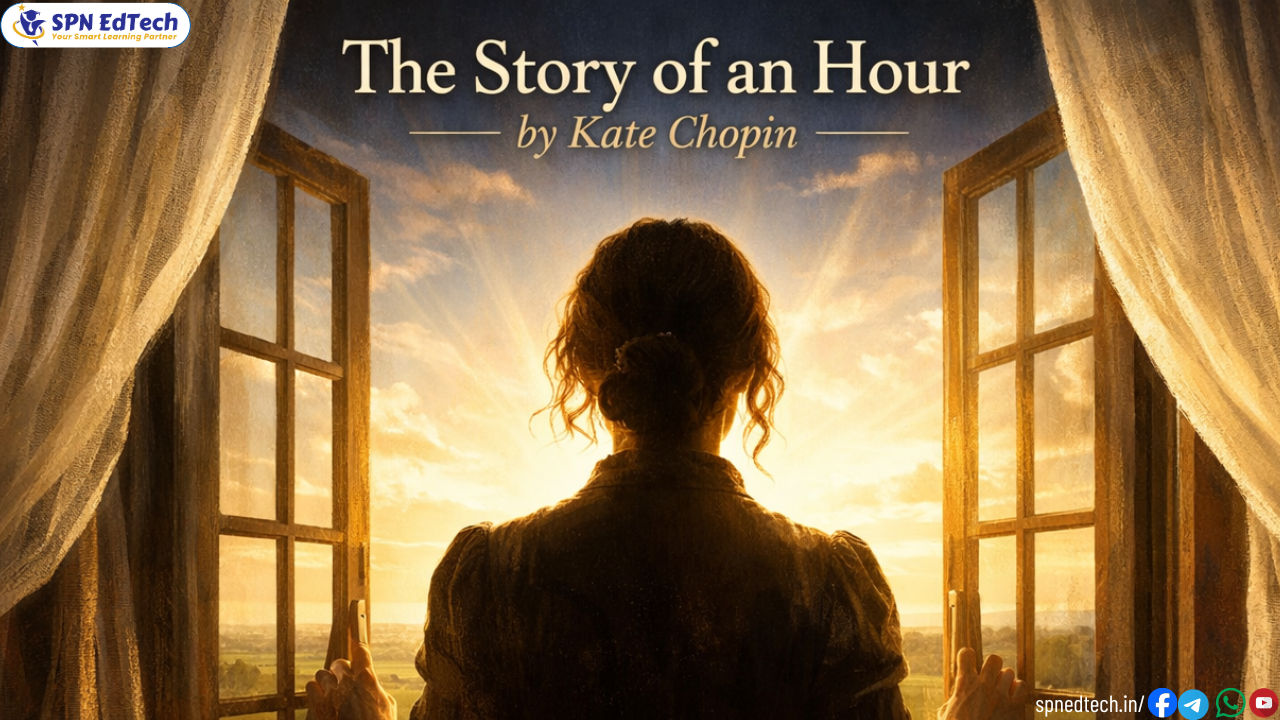
The Window Symbolism: When Louise looks out the window, she sees "blue sky," "sparrows," and "new spring life." This represents the world of possibilities and the freedom that awaits her.
Exam Tips: Focus on the shift in Louise's emotions—from grief to epiphany to tragic death. Pay attention to the use of "Heart Trouble" as both a physical condition and a metaphor for her emotional state.
6. Character Sketch
1. Louise Mallard: The protagonist. She is portrayed as a woman with "heart trouble," implying fragility. However, she possesses a strong internal desire for autonomy. She is not a villain for feeling happy; rather, she is a victim of a society that limits women's roles to being wives.
2. Brently Mallard: Louise’s husband. He is described as kind and loving. His character is important because his "kindness" proves that even a good marriage can be restrictive. He represents the traditional patriarchal figure of the era.
3. Josephine: Louise’s sister. She represents the "ideal" woman of the time—nurturing and concerned with social decorum. She embodies the traditional view that a woman’s life is centered around her family.
4. Richards: Brently’s friend. He is the one who brings the news. He represents the bridge between the outside world (the accident/railroad) and the domestic sphere.
7. Symbolism (Literary Devices)
- Heart Trouble: Symbolizes Louise’s emotional dissatisfaction and her physical weakness.
- The Open Window: Symbolizes the freedom and opportunities available to Louise once she is no longer bound by marriage.
- Springtime: Represents "new life" and rebirth, mirroring Louise's internal awakening.
- Irony: The ending is a classic example of Situational Irony (the husband is alive) and Dramatic Irony (the characters think she died of joy, but we know it was despair).
8. MCQ Section (Practice Questions)
(a) Richards (b) Josephine (c) The Doctor (d) Brently himself
Ans: (b) Josephine
(a) A boat accident (b) A railroad disaster (c) A heart attack (d) Old age
Ans: (b) A railroad disaster
(a) Lung disease (b) Blindness (c) Heart trouble (d) Amnesia
Ans: (c) Heart trouble
(a) A storm (b) New spring life (c) A funeral (d) Her husband
Ans: (b) New spring life
(a) "No, no" (b) "Free, free, free" (c) "Help me" (d) "Goodbye"
Ans: (b) "Free, free, free"
(a) A phone call (b) A second telegram (c) A newspaper report (d) He saw it happen
Ans: (b) A second telegram
(a) One day (b) One week (c) One hour (d) One year
Ans: (c) One hour
(a) Winning a prize (b) Her husband’s death (c) The prospect of freedom (d) Seeing her sister
Ans: (c) The prospect of freedom
(a) Angry (b) Kind and composed (c) Terrified (d) Strange
Ans: (b) Kind and composed
(a) Extreme sadness (b) The joy that kills (c) Exhaustion (d) Poison
Ans: (b) The joy that kills
(a) Humorous (b) Optimistic (c) Deeply ironic (d) Religious
Ans: (c) Deeply ironic
(a) Josephine (b) Richards (c) Louis (d) Kate
Ans: (b) Richards
(a) To the garden (b) To her room alone (c) To the hospital (d) To the church
Ans: (b) To her room alone
(a) 18th (b) 19th (c) 20th (d) 21st
Ans: (b) 19th
(a) Death (b) Freedom and future (c) Poverty (d) Fear
Ans: (b) Freedom and future
(a) She hated him (b) She loved him sometimes (c) She never knew him (d) She was afraid of him
Ans: (b) She loved him sometimes
(a) Laughing (b) Kneeling and begging her to open (c) Sleeping (d) Cooking
Ans: (b) Kneeling and begging her to open
(a) Dark and gloomy (b) Bright and full of life (c) Industrial and grey (d) Chaotic
Ans: (b) Bright and full of life
(a) Romanticism (b) Realism (c) Surrealism (d) Modernism
Ans: (b) Realism
(a) Virginia Woolf (b) Kate Chopin (c) Sylvia Plath (d) Emily Dickinson
Ans: (b) Kate Chopin
9. One-Line Revision (Last Minute Notes)
- 🔹 Louise Mallard has heart trouble and hears her husband died in a train accident.
- 🔹 She feels a sudden, overwhelming sense of freedom and independence in her room.
- 🔹 The "open window" represents the bright future she imagines without a husband.
- 🔹 Brently Mallard returns home alive, proving the report of his death was false.
- 🔹 Louise dies instantly of a heart attack upon seeing him.
- 🔹 The doctors' diagnosis "joy that kills" is the ultimate dramatic irony.
Study Notes PDF
Download this article for offline study







Social Platforms