
1. Basic Information
Written in 1919 in the aftermath of World War I, "The Second Coming" is one of the most famous and frequently quoted poems in Modernist literature. It captures the atmosphere of a world spiraling out of control, blending historical anxiety with mystical prophecy.
- 📖 Chapter Name: The Second Coming
- ✍️ Poet: William Butler Yeats (W.B. Yeats)
- 🏫 Class : 11 (Semester-1)
- 📌 Genre: Modernist Poetry / Symbolic Poem
2. Author Introduction
William Butler Yeats (1865–1939) was an Irish poet, dramatist, and one of the foremost figures of 20th-century literature. He was a pillar of the Irish Literary Revival and was awarded the Nobel Prize in Literature in 1923.
Yeats’s writing style evolved from early Romanticism and Irish folklore to a complex, symbolist Modernism. His later works are marked by a unique mystical system called "A Vision," which involves historical cycles known as Gyres. Some of his famous works include The Tower, The Winding Stair, and Sailing to Byzantium.
3. Full Summary
The poem is divided into two stanzas, representing the observation of chaos and a terrifying vision of the future.
Stanza 1: The Chaos of the World
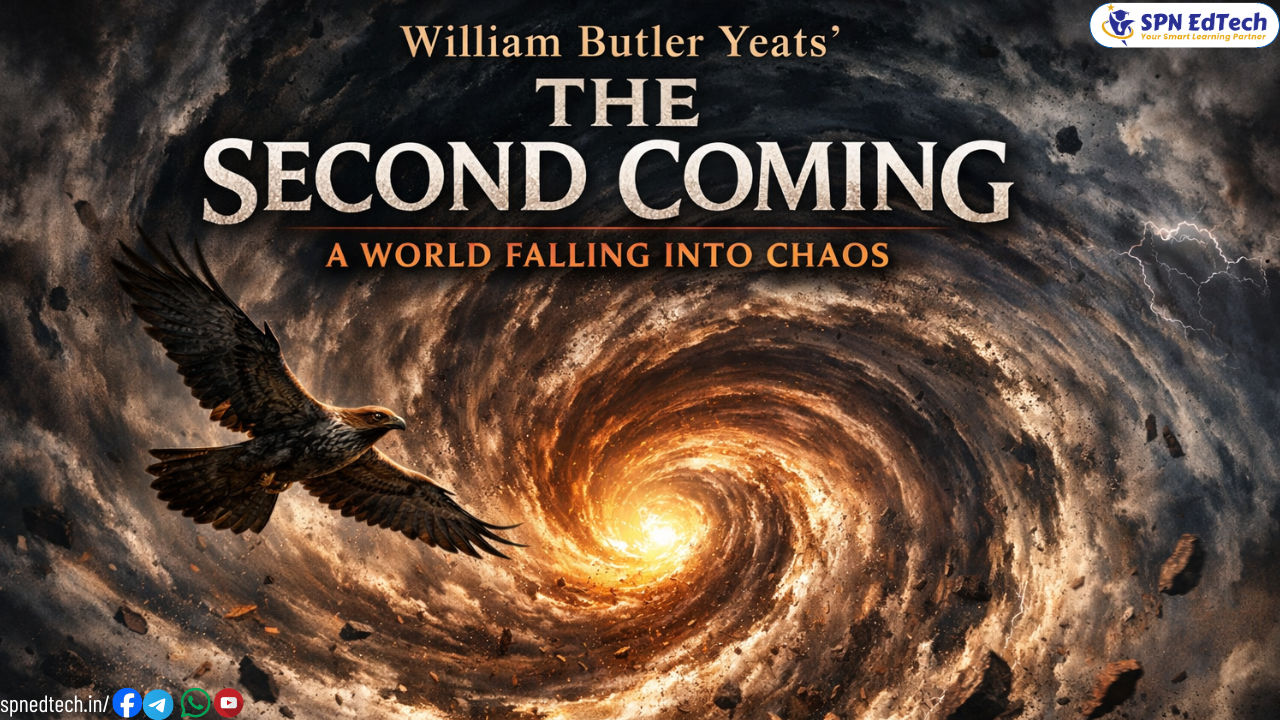
The poet describes a world that is falling apart. He uses the image of a falcon flying too far from the falconer, symbolizing humanity losing touch with tradition and order. "The center cannot hold," suggesting that society is collapsing into anarchy. Yeats notes that the "best" people lack conviction, while the "worst" are full of violent intensity.
Stanza 2: The Prophecy
The poet concludes that some great revelation is near. He invokes the "Spiritus Mundi" (the collective soul of the universe) and sees a terrifying vision: a creature with a lion’s body and a human head (the Sphinx) moving across the desert. This "rough beast" represents the end of the 2,000-year cycle of Christianity and the birth of a new, darker era. Instead of the gentle Second Coming of Christ, this is a nightmarish arrival.
4. Theme / Central Idea
- Cyclical Nature of History: Yeats believed history moves in 2,000-year cycles. The Christian era is ending, and a new, chaotic era is beginning.
- Anarchy and Collapse: The poem reflects the political unrest in Ireland and the devastation of WWI. It warns that when social structures fail, chaos takes over.
- Loss of Control: The metaphor of the falconer and the falcon highlights the breakdown of communication and authority.
5. Important Explanation
"Things fall apart; the centre cannot hold;"
This is perhaps the most famous line in modern poetry. It suggests that the moral and social foundations of Western civilization are breaking. There is no longer a central authority or belief system to keep the world together.
"The blood-dimmed tide is loosed..."
This refers to the widespread violence of war. The "tide" suggests an unstoppable force of destruction that drowns the "ceremony of innocence."
"Slouches towards Bethlehem to be born?"
Bethlehem is the birthplace of Christ. By using this location for the "rough beast," Yeats suggests that the next era will be the antithesis (opposite) of the peaceful Christian values we know.
7. Symbolism & Imagery
- The Gyre: A spiraling motion representing the cycles of history.
- The Falcon and Falconer: Symbolizes the relationship between man and God, or the individual and social order.
- Spiritus Mundi: A "world spirit" or collective storehouse of images that Yeats believed poets could tap into.
- The Rough Beast: A symbol of a new, pagan, and violent era that replaces the Christian age.
8. Multiple Choice Questions (MCQs)
(a) 1914 (b) 1919 (c) 1939 (d) 1923
Ans: (b) 1919
(a) A storm (b) A bird's nest (c) The spiral of history (d) A dance
Ans: (c) The spiral of history
(a) The Eagle (b) The Falcon (c) The Raven (d) The Dove
Ans: (b) The Falcon
(a) Break (b) Hold (c) Move (d) Fall
Ans: (b) Hold
(a) The city (b) The ceremony of innocence (c) The desert (d) The falconer
Ans: (b) The ceremony of innocence
(a) Money (b) Power (c) Conviction (d) Intelligence
Ans: (c) Conviction
(a) Fear (b) Passionate intensity (c) Greed (d) Laziness
Ans: (b) Passionate intensity
(a) The Bible (b) Spiritus Mundi (c) A dream (d) Greek mythology
Ans: (b) Spiritus Mundi
(a) Body of a man, head of a lion (b) Body of a lion, head of a man (c) Wings of an eagle (d) Scales of a dragon
Ans: (b) Body of a lion, head of a man
(a) Angry (b) Blank and pitiless as the sun (c) Kind and gentle (d) Sad and tearful
Ans: (b) Blank and pitiless as the sun
(a) London (b) Bethlehem (c) Dublin (d) Rome
Ans: (b) Bethlehem
(a) 100 years (b) 500 years (c) 1,000 years (d) 2,000 years
Ans: (d) 2,000 years
(a) A rocking chair (b) A rocking cradle (c) An earthquake (d) A storm
Ans: (b) A rocking cradle
(a) WWII (b) WWI (c) The French Revolution (d) The Great Depression
Ans: (b) WWI
(a) Romanticism (b) Modernism (c) Victorianism (d) Neoclassicism
Ans: (b) Modernism
(a) Joyful (b) Ominous and apocalyptic (c) Humorous (d) Romantic
Ans: (b) Ominous and apocalyptic
(a) The return of a king (b) The biblical return of Christ (c) A political election (d) A solar eclipse
Ans: (b) The biblical return of Christ
(a) Shadows of clouds (b) Shadows of the indignant desert birds (c) Shadows of palm trees (d) Shadows of men
Ans: (b) Shadows of the indignant desert birds
(a) Nature (b) Logic, control, or God (c) Chaos (d) War
Ans: (b) Logic, control, or God
(a) Ernest Hemingway (b) Chinua Achebe (c) F. Scott Fitzgerald (d) Virginia Woolf
Ans: (b) Chinua Achebe (Things Fall Apart)
9. One-Line Revision
- Poet: W.B. Yeats, an Irish Nobel Laureate and Modernist.
- Key Image: The widening gyre and the falcon losing touch with the falconer.
- The Crisis: Anarchy is loosed upon the world and the "centre cannot hold."
- The Vision: A pitiless Sphinx-like creature rising from the Spiritus Mundi.
- Historical Context: Reflects post-WWI disillusionment and the end of a 2,000-year cycle.
- Final Warning: The "Second Coming" is not a savior, but a "rough beast" slouching toward Bethlehem.
Study Notes PDF
Download this article for offline study







Social Platforms