
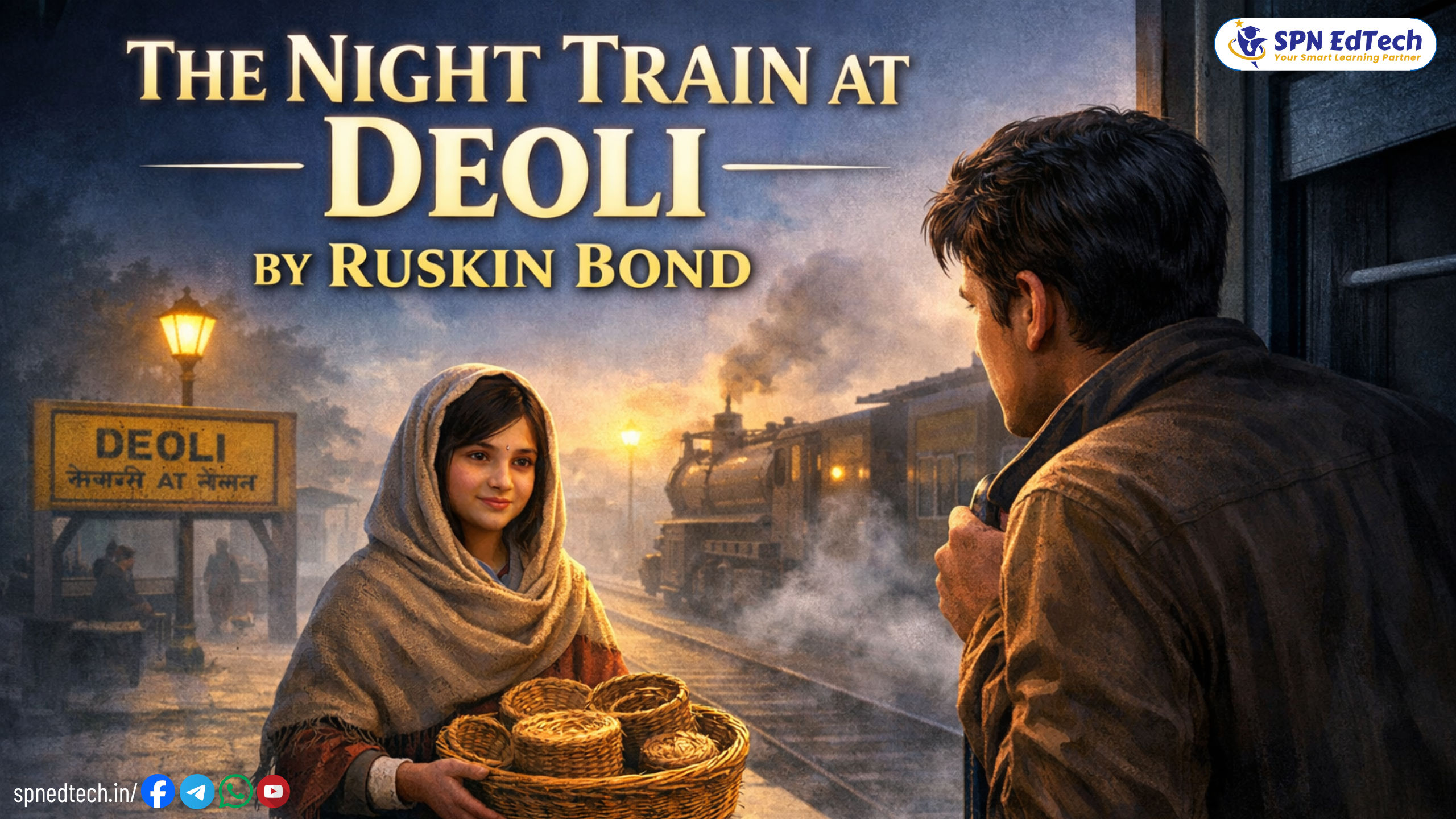
Short Intro: A hauntingly beautiful story of a brief, unspoken encounter between a young college student and a poor basket-seller at a small, lonely railway station. It explores the themes of longing, youth, and the mystery of strangers.
📖 Chapter Name: The Night Train at Deoli
✍️ Author: Ruskin Bond
🏫 Class: 12 (Semester-3)
📌 Genre: Short Story / Romantic Realism
Ruskin Bond is an iconic Anglo-Indian author, renowned for his role in the growth of children's literature in India. Born in 1934 in Kasauli, he has spent most of his life in the Himalayan foothills, which heavily influences his writing style. His prose is characterized by simplicity, lucidity, and a deep empathy for nature and the common man.
Famous Works: The Room on the Roof, Our Trees Still Grow in Dehra, The Blue Umbrella, and A Flight of Pigeons.
Style: Bond’s writing is often semi-autobiographical, focusing on nostalgia, the beauty of the ordinary, and gentle human emotions without being overly dramatic.
The story is narrated by a college student who spends his summer vacations at his grandmother’s house in Dehra. His train journey involves passing through a small, isolated station called Deoli. Deoli is a place where nothing ever seems to happen and no one ever gets off, yet the narrator is strangely fascinated by it.
One night, while the train is stopped at Deoli, the narrator sees a girl selling cane baskets on the platform. She is poor but possesses a dignified grace and "dark, searching eyes." A silent connection is established between them. He buys a basket he doesn't need just to interact with her. The encounter is brief but leaves a lasting impression on his mind.
During his return journey, he looks for her again. They meet, and though few words are exchanged, the bond strengthens. He feels a sense of responsibility toward her and dislikes the idea of leaving her behind. She expresses her feelings through her eyes, hinting that she will be there when he returns.
However, the following year, the girl is nowhere to be found. The narrator is deeply anxious and asks the station master and others about her, but no one knows who she was. Despite his urge to break his journey and find her in the village, he never does. He chooses to keep the memory of her alive as a "sweet dream" rather than face a potentially harsh reality. He continues to travel through Deoli, always hoping to catch a glimpse of the girl again, but he never sees her again.
Unrequited Love & Longing: The story captures the essence of a fleeting romance that was never fulfilled, leaving behind a permanent sense of "what if."
The Beauty of the Imperfect: Bond suggests that some stories are more beautiful because they remain unfinished. The mystery of the girl is more powerful than the reality of finding her.
Transience of Life: It reflects how people enter and exit our lives like trains passing through a station, leaving behind only memories.
The Significance of Deoli: Deoli represents a "liminal space"—a middle ground between the narrator's busy college life and his grandmother's home. It is a place of stillness where time stops for a few minutes.
The Narrator’s Dilemma: In the end, the narrator decides not to get off the train to search for the girl. This is a crucial point for exams. It shows his fear of shattering a beautiful memory. He prefers the "hope" of seeing her over the "certainty" of finding out she might be gone or changed.
Symbolism of Baskets: The baskets represent the girl's labor and poverty, but for the narrator, they are the only physical link to his silent beloved.
The Narrator: A young, sensitive, and romantic college student. He is an observer of life and is easily moved by beauty. His decision to keep the mystery alive shows his poetic and cautious nature.
The Basket Girl: She is the personification of "mysterious beauty." Despite her poverty, she is not portrayed as a victim but as someone with dignity and strength. Her "searching eyes" suggest she is also looking for something beyond the lonely station of Deoli.
The Station Master: A minor character who represents the mundane world. He is indifferent to the narrator’s emotional turmoil, highlighting the personal nature of the narrator's experience.
Imagery: Bond uses vivid visual imagery to describe the platform—the "dimly lit station," the "clanging of the bell," and the "cold morning air."
Metaphor: The train journey is a metaphor for the journey of life, where we meet people briefly and move on.
Atmosphere: The mood is nostalgic, melancholic, and romantic. The use of the "night train" setting adds a layer of dream-like quality to the narrative.
Symbolism: The train = life’s unstoppable journey; Deoli = lost opportunity; basket = a token of memory; the girl = unattainable love.
(a) Dehra (b) Delhi (c) Deoli (d) Mussoorie
Ans: (a) Dehra
(a) Noon (b) Midnight (c) Early Morning (d) Evening
Ans: (c) Early Morning
(a) Flowers (b) Baskets (c) Tea (d) Books
Ans: (b) Baskets
(a) Once (b) Twice (c) Three times (d) Never
Ans: (b) Twice
(a) Pity (b) Fear (c) Instant attraction (d) Indifference
Ans: (c) Instant attraction
(a) He needed one (b) To help her (c) As a souvenir (d) To keep her near him longer
Ans: (d) To keep her near him longer
(a) She moved away (b) She is married (c) He didn't notice her (d) She was ill
Ans: (c) He didn't notice her
(a) He is lazy (b) He is afraid of the truth (c) He has an exam (d) The train was moving too fast
Ans: (b) He is afraid of the truth
(a) Blue and bright (b) Dark and searching (c) Sad and tired (d) Small and shy
Ans: (b) Dark and searching
(a) 1934 (b) 1947 (c) 1920 (d) 1950
Ans: (a) 1934
(a) In a city (b) Near Saharanpur (c) On the way to Dehra (d) In Mussoorie
Ans: (c) On the way to Dehra
(a) They get married (b) He finds her (c) It remains an unsolved mystery (d) He forgets her
Ans: (c) It remains an unsolved mystery
(a) Humorous (b) Satirical (c) Nostalgic (d) Tragic
Ans: (c) Nostalgic
(a) School student (b) College student (c) PhD scholar (d) Lawyer
Ans: (b) College student
(a) Winter (b) Summer (c) Monsoon (d) Autumn
Ans: (b) Summer
(a) Nightmare (b) Game (c) Sweet dream (d) Debt
Ans: (c) Sweet dream
(a) Booker Prize (b) Sahitya Akademi (c) Nobel Prize (d) Pulitzer
Ans: (b) Sahitya Akademi
(a) A uniform (b) A shawl (c) A silk sari (d) A heavy coat
Ans: (b) A shawl
(a) Stays in Dehra (b) Goes to Deoli (c) Returns to his university/parents (d) Quits his studies
Ans: (c) Returns to his university/parents
(a) Hero (b) Coward (c) Stranger (d) King
Ans: (b) Coward
- The story is set at the lonely railway station of Deoli during a summer trip to Dehra.
- A college student falls in love with a basket-seller girl during a brief train halt.
- The connection is silent, built through intense eye contact and minimal dialogue.
- On his return and subsequent trips, the girl vanishes, leaving the narrator heart-broken.
- The narrator decides not to find the truth to preserve the romantic memory of the girl.
- Key themes include unfulfilled longing, the beauty of chance encounters, and youth.
Study Notes PDF
Download this article for offline study







Social Platforms